Why this matters
Around 29 and 58, Saturn returns to where it was at your birth. How to find your exact window, what it tests, and how to use it well.
Around 29, and again around 58, Saturn comes back to where it stood when you were born. People remember it as a reckoning. The ones who use it well remember it as the year they stopped pretending.
Search "Saturn return" and you will find a lot of fear: breakups, quitting jobs, the "quarter-life crisis" with a planet attached. Some of that is real. Most of it misses the point. A Saturn return is the clearest scheduled event in a birth chart, it is calculable to the week, and it is far more useful as a planning tool than as a warning. This guide explains what it is, how to find exactly when yours hits, what it tends to test, and what to do with it.
Definition
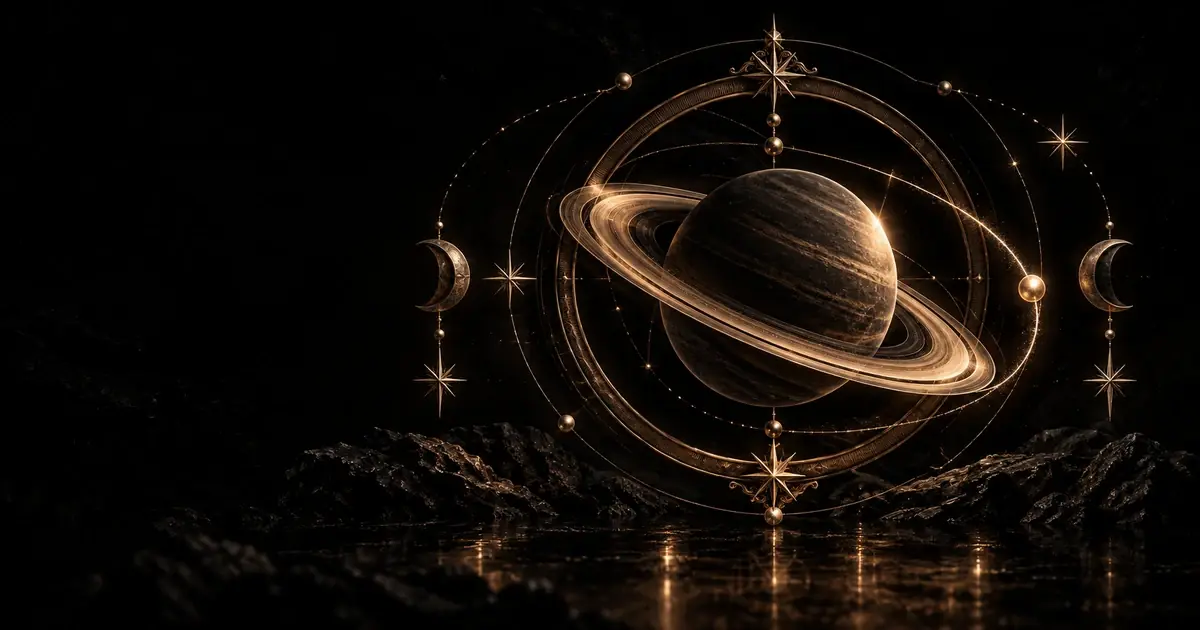
Saturn takes about 29.5 years to orbit the Sun. So at some point in your late twenties, it returns to the exact zodiac degree it occupied at your birth. That return is your first Saturn return. The second comes around age 58–59, and a third around 88.
Because Saturn appears to move backwards for about four and a half months every year (its retrograde), it often crosses your natal degree three times — forward, backward, forward again — over roughly a year. And astrologers read the effect from about the moment Saturn enters the same sign, so the full window is usually two to three years.
In the tradition, Saturn is the planet of structure, limits, time, responsibility and consequences. It is the auditor of the chart. Its return is read as the point where the accounts come due: whatever you built on solid ground holds, and whatever you built on borrowed assumptions gets tested.
How to Find It
You need your birth date. The exact time matters less here than for most techniques, because Saturn moves slowly — about a degree a week at most.
- 1.Find your natal Saturn. Any chart calculator shows its sign and degree — for example, Saturn at 14° Aries.
- 2.Find when transiting Saturn reaches that degree. An ephemeris or a transit tool lists the dates. With retrograde, expect one to three exact hits.
- 3.Mark the whole window. From Saturn's entry into your natal Saturn sign to its exit is the full season, typically two to three years.
Rough guide for readers today, by birth year:
| Born roughly | Natal Saturn in | First return around |
|---|---|---|
| 1994 – early 1996 | Pisces | 2023 – early 2026 |
| mid 1996 – early 1999 | Aries | 2025 – 2028 |
| mid 1998 – 2001 | Taurus | 2028 – 2030 |
| 1967 – early 1969 | Aries | second return, 2025 – 2028 |
Sign boundaries are approximate; Saturn dipped back and forth across them in several of those years. Check your own chart rather than the table if you were born near a boundary year. For the current passage through Aries, including its retrograde, see Saturn retrograde in Aries (2026).
How to Interpret It
The return is read through three things: the house Saturn occupies in your chart, the house it rules (the house with Capricorn on it, and traditionally Aquarius too), and what you have actually been building for the past three decades.
What it tests
Saturn returns tend to land on the same questions for almost everyone, because they arrive when life asks them anyway:
- Work: Is this a career or a job I drifted into? Am I building skill or just holding a position?
- Relationships: Is this commitment chosen, or is it inertia? Am I with this person, or with the idea of settling down?
- Self-reliance: Am I living by my own standards or by my parents', my friends', my feed's?
- Time: What can I no longer postpone?
Read the house
Where Saturn sits in your chart tells you which of those questions is loudest. Saturn in the 10th makes the return a career audit. In the 7th, a relationship audit. In the 4th, a home and family audit — often a move, or taking on responsibility for a parent. In the 2nd, money: debt, earnings, what you are actually worth in the market. The houses guide has the full list: the 12 houses explained.
The advantage nobody mentions
A Saturn return is a rare moment when effort and reward line up unusually well. Saturn rewards exactly three things: commitment, patience and taking responsibility for your own results. People who meet the return by committing to something — a craft, a business, a relationship they choose deliberately, a health habit — very often look back on it as the start of the most solid decade of their lives. People who spend it resisting tend to experience the same period as a series of doors closing.
So the practical reading is not "brace for impact". It is: what would you build if you knew you would still be doing it at forty? Start that during the return.
A simple plan for the window
- 1.Six months before: list what you are carrying out of habit — jobs, commitments, beliefs, subscriptions to other people's expectations.
- 2.During: end one thing that no longer fits and commit to one thing that does. Just one of each. Saturn prefers depth to volume.
- 3.After: expect results to arrive slowly. The payoff of a Saturn return usually shows in the three to seven years that follow, not during it.
The second return
Around 58, the same audit comes back with a different subject: legacy. What do you want the next thirty years to be about? What do you hand on, and what do you finally put down? People who have been through the first return consciously often find the second calmer — they already know the shape of the test.
Worked Examples
Saturn in the 10th, born 1997. Their return runs roughly 2025 to 2028 while Saturn moves through Aries. At 29 they are two promotions into a corporate role they never chose. The return surfaces the question directly: is this the career, or a holding pattern? Read well, the move is not to quit dramatically but to commit — to either get the qualification that makes this a real profession, or to start building the alternative seriously, with a timeline. Either choice satisfies Saturn. Drifting does not.
Saturn in the 7th, born 1995. Their return fell across 2023 to early 2026. A long relationship that began at 21 either deepens into a chosen commitment or ends. Both outcomes are common. The question the return keeps asking is whether the relationship is being maintained by decision or by habit. The advantage: whichever way it goes, they come out knowing what they want from a partner — usually for the first time.
Saturn in the 4th, second return, born 1968. Their second return runs 2025 to 2028. Grown children leaving, ageing parents needing care, and the question of where to live for the next chapter. Saturn in the 4th makes the home itself the project. A good use of the window: make the decision about the house, the caregiving and the next move deliberately, rather than letting circumstances decide by default.
Limits and Variations
It is a season, not a date. The exact hits are dates; the experience is a two-to-three-year arc. Nothing reliably happens on the exact day.
Life stage does a lot of the work. Late twenties and late fifties are transitions in most cultures regardless of astrology. A sceptic would say the Saturn return is a name for a life stage; the tradition would say the timing is the point. Either way, using the window deliberately costs nothing.
Not every return is dramatic. People who have already been living by their own choices often experience it as confirmation — a promotion, a wedding, a business that finally holds — rather than upheaval.
This is a symbolic framework. Saturn's orbital period and positions are precise astronomy you can check against NASA data. The meaning attached to its return is an interpretive tradition, not a scientifically demonstrated effect. Nothing here is medical, financial or legal advice; big decisions deserve real-world advice too.
Keep going
Saturn's return is a transit — a moving planet meeting a point in your birth chart. To read any other transit the same way, see how to read any transit by your Rising sign. For how a hard Saturn contact reads between two people, see synastry: why some charts click and others grind.
Sources
Saturn's orbital period and positions are standard astronomy and can be checked against the reference ephemeris below. The interpretation of Saturn as the planet of structure, limits and time comes from the Hellenistic and later Western astrological tradition and is presented as symbolic, not scientific.
- Saturn: Facts — NASA Science — NASA. Saturn's orbital period of about 29.4 Earth years.
- JPL Horizons System — NASA Jet Propulsion Laboratory. Reference ephemeris for calculating when transiting Saturn returns to a natal degree.
- Hellenistic Astrology: The Study of Fate and Fortune — Chris Brennan. Traditional significations of Saturn and the use of planetary returns.
Editorial record
Sources and calculation
Saturn's orbital period and positions are standard astronomy and can be checked against the reference ephemeris below. The interpretation of Saturn as the planet of structure, limits and time comes from the Hellenistic and later Western astrological tradition and is presented as symbolic, not scientific.
Sources
- Saturn: Facts — NASA Science — NASASupports: Saturn's orbital period of about 29.4 Earth years.
- JPL Horizons System — NASA Jet Propulsion LaboratorySupports: Reference ephemeris for calculating when transiting Saturn returns to a natal degree.
- Hellenistic Astrology: The Study of Fate and Fortune — Chris BrennanSupports: Traditional significations of Saturn and the use of planetary returns.
Did this answer your question?
One tap. No account needed.
Read your own birth chart, free.
Your Rising sign, Moon and houses in plain English. Saved to your account, so every article opens on your signs.
Free account · no credit card needed
Or get the Premium Pass: $12.99 once, no subscription