Why this matters
The Fool means a start you cannot fully plan for. What it says upright and reversed, what its creator actually wrote, and three questions to use when it appears.
Most guides say The Fool means "new beginnings." The man who designed the most copied tarot deck gave it a list closer to "recklessness." You can use both.
The Fool tarot card means a start you cannot fully plan for: a new job, a move, a relationship, a first try at something. Upright, it asks you to step in with curiosity. Reversed, it points to one of two problems, either a leap you are taking without looking or a leap you keep refusing to take.
This guide covers what the card shows, how the meaning shifts in love, work and money, where the popular reading leaves something out, and three questions you can use the next time it turns up in your spread.
Core Meaning
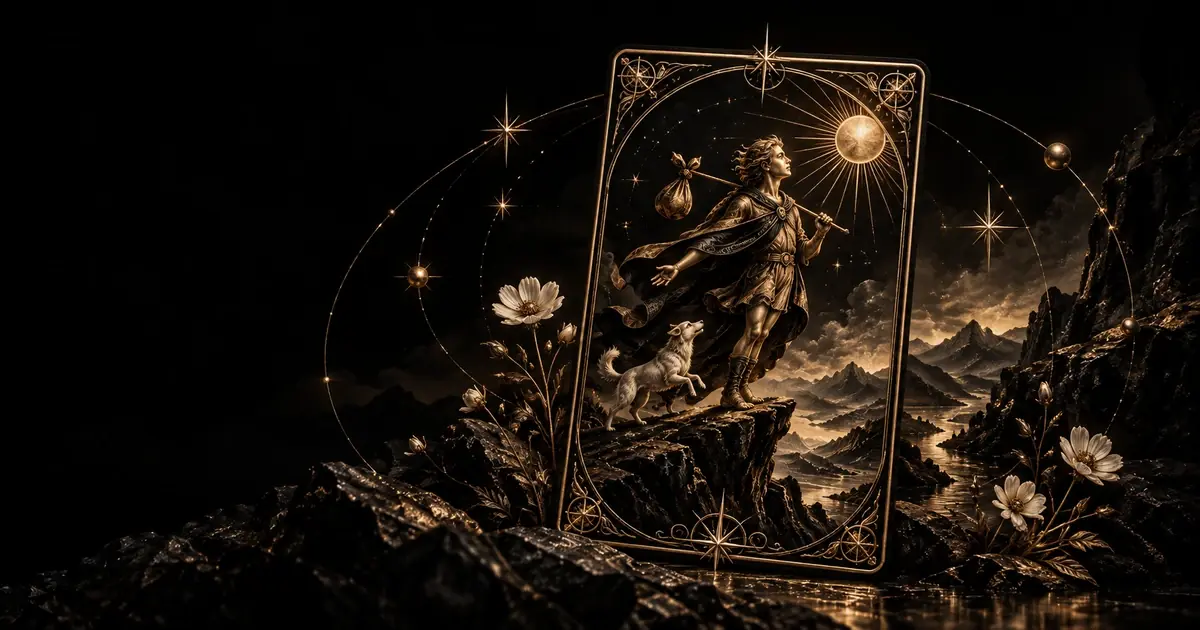
In the Rider-Waite-Smith deck, the one most modern decks copy, a young man in bright clothes stands at the edge of a cliff. He looks up at the sky, not down at the drop. He carries a white rose in one hand and a small bag on a stick over his shoulder. A white dog jumps at his heels.
Modern readers mostly agree on the keywords: beginnings, openness, trust, spontaneity, beginner's luck. The number zero on the card is often read as pure potential, the moment before anything has happened.
Most guides leave out where that reading came from. Arthur Edward Waite, who designed that deck with the artist Pamela Colman Smith and published his guide in 1910, gave the upright Fool a much darker list: folly, mania, extravagance, intoxication, frenzy. He also wrote that the card has no real number. In his words, "the Zero is an unnumbered card," and in his own book he placed it between card 20 and card 21, not at the front.
So the idea of The Fool as the cheerful first step through the story of the major arcana is a later reading. It is a useful one, and most readers today use it. But the older meaning is worth keeping in your pocket, because it explains the reversed card and the shadow side better than "new beginnings" ever could.
A simple way to hold both: The Fool is the moment you step into something you do not fully understand yet. Whether that is brave or foolish depends on what you are ignoring.
Context Variations
The card changes weight depending on the question you asked.
Love and relationships
Upright, The Fool often shows up at the start of something: a new person, a first date after a long gap, or a relationship moving into unknown ground, like moving in together. It favours honesty over strategy. If you are single, it can suggest saying yes to a plan you would normally skip.
In an existing relationship, it asks whether the two of you still try new things together or have settled into a script.
Work and career
Upright, it fits a new role, a side project, a career change, or the first weeks of learning a skill. It rewards asking beginner questions out loud. Many people find the card lands right when they feel least qualified.
Money
Here the older meaning matters most. Waite's "extravagance" is a fair warning. The Fool in a money question is a reason to slow down before a purchase or a bet that feels exciting. Tarot is not financial advice. Use the card as a prompt to check your numbers, not as a reason to spend.
Reversed
Reversed, The Fool splits into two opposite readings, and your situation tells you which one fits:
- •The careless leap. You are moving fast and skipping the part where you look down. Waite listed negligence and carelessness for the reversed card.
- •The leap you will not take. You have been ready for months and keep waiting for a sign, calling your fear caution.
Ask yourself which of the two made you wince. That is usually the one.
As advice or outcome
In the advice position, it tells you to begin before you feel ready. In an outcome position, it points to ending up somewhere new, with no promise about how it goes, and a lot to learn once you get there.
Opportunity and Shadow
Every major arcana card has a helpful side and a side that trips you up. The Fool's two sides are unusually close together.
Opportunity:
- •Curiosity that makes learning fast
- •Willingness to look silly in front of others
- •Less baggage from past failures
- •Trust that you can figure it out on the way
Shadow:
- •Ignoring information you do not want to hear
- •Starting things and never finishing them
- •Treating every restless feeling as a sign to quit
- •Risk that falls on other people, not just you
The dog on the card is a nice detail here. Some readers see it as loyalty. Others see it as a warning bark. Either way, it stands for the voice that notices the cliff. The Fool at its best hears that voice and walks on anyway, with eyes open.
Reading about the cards is one thing. Pulling your own is another.
Get a personal AI tarot reading on the question that’s actually on your mind — free to start.
Did this answer your question?
One tap. No account needed.
How to Work With It
When The Fool appears, try these three questions. Write a one-line answer to each.
- 1.What am I starting, or about to start? Name it plainly. If nothing comes to mind, look for the thing you keep daydreaming about.
- 2.What am I not looking at? This is the cliff. It might be money, time, another person's feelings, or a skill you do not have yet.
- 3.What is the smallest real step? Not the whole leap. One email, one class, one honest conversation this week.
Card meanings are broad on purpose, and broad statements feel personal to almost everyone. Psychologist Bertram Forer showed this in 1949: students rated a generic personality sketch as a close fit, even though every student got the same text. That effect is why a reading can feel eerily accurate. It is also why the three questions matter. They force the card to meet the specific facts of your week instead of floating above them.
Here is how that looks in practice.
Priya pulls The Fool upright while deciding whether to apply for a design course at 38. Her first answer is easy: the course. Her second answer takes longer: she has not checked whether the evening schedule works with her kids' pickup. Her smallest step is to email the course office about the timetable. She now has what she needs to decide, which is all the card asked of her.
Jonah gets The Fool reversed in a question about his relationship. He reads it as the careless leap at first, then admits the truth is the other one. He and his partner have talked about moving cities for two years and never looked at a single apartment. His smallest step is a Saturday morning spent browsing listings together, just to see how it feels.
Elena draws it in a money reading the week she is about to put her savings into a friend's new business. The card excites her. Question two stops her: she has never seen the business plan. She asks for it before she transfers anything. Here Waite's old word, extravagance, fits better than any modern keyword.
If you are new to spreads, our [beginner's guide to reading tarot](/blog/tarot-reading-beginners-guide) explains positions like advice and outcome. To see how The Fool fits with the other 77 cards, start from our [complete guide to tarot card meanings](/blog/tarot-card-meanings-complete-guide-78-cards).
FAQ
Is The Fool a good card?
It is mostly read as positive, especially upright. It points to a fresh start and openness. It still carries a warning about ignoring risk, so read it together with the cards around it.
What does The Fool mean in love?
Upright, it usually signals something new or a chance to be more playful and honest. Reversed, it can point to rushing in too fast or holding back from a step you both want.
Why is The Fool numbered zero?
In most modern decks it carries a zero to show potential before anything begins. Historically it had no fixed number. Waite himself called it unnumbered and placed it near the end of the trumps.
Does The Fool mean I should quit my job?
No card can tell you that. The Fool can point to a restlessness worth looking at. Use the three questions above to find a small, concrete step, and get proper advice for big financial or legal choices.
Sources
- •Waite, A. E. (1910). The Pictorial Key to the Tarot, Part 2: The Doctrine Behind the Veil. London: William Rider & Son.
- •Waite, A. E. (1910). The Pictorial Key to the Tarot, Part 3: The Outer Method of the Oracles. London: William Rider & Son.
- •Forer, B. R. (1949). The fallacy of personal validation: A classroom demonstration of gullibility. The Journal of Abnormal and Social Psychology, 44(1), 118–123.
Editorial record
How this article was verified
Card imagery and the historical meanings come from A. E. Waite's 1910 guide to the Rider-Waite-Smith deck, quoted from the public-domain text. Modern meanings reflect common reader practice and are presented as symbolic prompts for reflection, not predictions. The note on why readings feel personal draws on Forer's 1949 study.
Sources
- The Pictorial Key to the Tarot, Part 2: The Doctrine Behind the Veil — William Rider & Son (1910), via WikisourceSupports: Waite's description of the Fool card and his statement that the Zero is an unnumbered card, placed after No. 20.
- The Pictorial Key to the Tarot, Part 3: The Outer Method of the Oracles — William Rider & Son (1910), via WikisourceSupports: Waite's divinatory meanings for the Fool: upright folly, mania, extravagance; reversed negligence, carelessness, apathy.
- The fallacy of personal validation: a classroom demonstration of gullibility — The Journal of Abnormal and Social PsychologySupports: Students rated one generic personality sketch as a close personal fit, showing why broad statements feel personal.
“These reading really are so on point. That I really wonder sometimes how it's possible to be so on point by just pulling a few cards.”
Anonymous
Tarot
Reading about the cards is one thing. Pulling your own is another.
Get a personal AI tarot reading on the question that’s actually on your mind — free to start.
Free account · no credit card needed
Compare subscription plans