Why this matters
Aspects show which parts of you are wired together. How to find the few that matter, and why squares and oppositions build your real strengths.
Signs describe the parts of you. Aspects describe how those parts argue — and the arguments are where your real strengths get built.
Ask someone what their chart says and they will usually give you three signs. Ask why they keep sabotaging the thing they want most, and the signs go quiet. That question is answered by aspects: the angles between planets, which show which parts of you are wired together and whether they cooperate or compete. This guide explains what aspects are, how to find the ones that matter, why the uncomfortable ones deserve most of your attention, and how to turn each kind into something you can use.
Definition
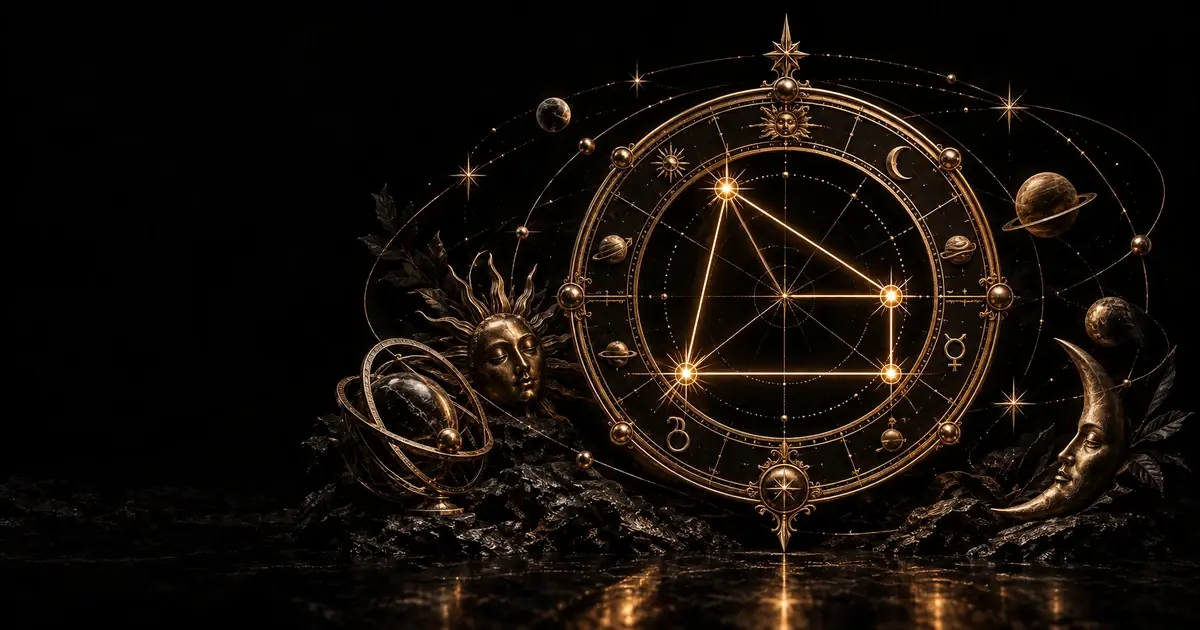
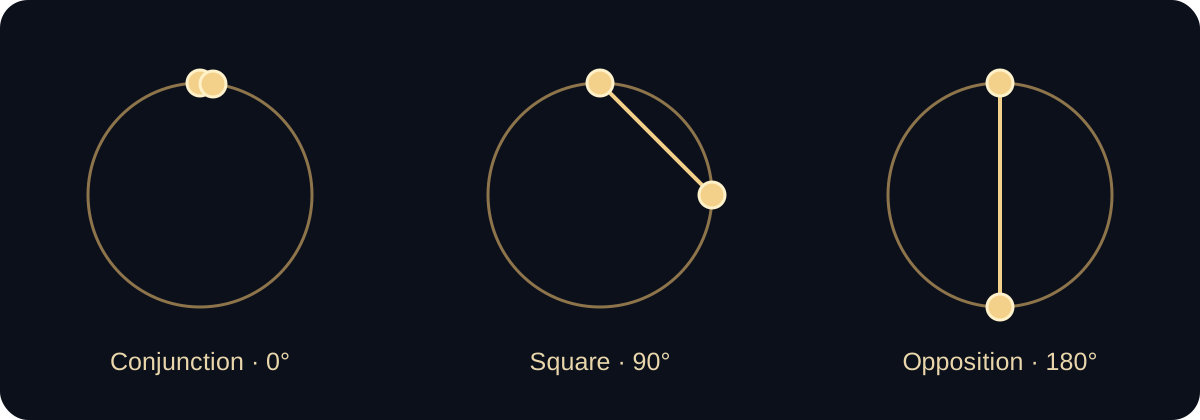
An aspect is a specific angle between two planets, measured around the 360° circle of the birth chart. Five angles have been read as meaningful since Hellenistic times:
| Aspect | Angle | Traditional reading |
|---|---|---|
| Conjunction | 0° | Two drives fused into one — they cannot act separately |
| Sextile | 60° | An open door — cooperation that needs a small push |
| Square | 90° | Friction — two drives that want different things at the same time |
| Trine | 120° | Flow — two drives that support each other without effort |
| Opposition | 180° | A tug-of-war — two drives that pull in opposite directions |
Planets are almost never exactly at those angles, so each aspect has a tolerance called the orb. A square is 90°, but planets 87° apart are still in square with a 3° orb. The tighter the orb, the stronger the aspect.
One more distinction does real work: an aspect is applying while the faster planet is still moving toward exact, and separating once it has passed. Applying aspects are read as building pressure; separating ones as something already lived through.
How to Find It
Any chart calculator lists your aspects, often as a triangular grid. The list can run to twenty or thirty entries, which is where most people give up. Do not read the list in order. Rank it.
- 1.Sort by orb. Anything under 1° is a defining feature of the chart. Under 3° is strong. Past about 6° (8° for the Sun and Moon), most astrologers stop reading it.
- 2.Prioritise the personal points. Aspects to the Sun, Moon, Ascendant and the ruler of your Ascendant describe you most directly. Aspects between two slow outer planets (Uranus, Neptune, Pluto) are shared by everyone born within months of you.
- 3.Flag the tense ones. Mark every square and opposition in your top five. These are where the chart's story is.
- 4.Check direction. For your top three, note whether each is applying or separating. The same square reads differently depending on which way it is moving.
When you are done, you should have three to five aspects that actually describe you — not thirty that describe everyone.
How to Interpret It
The rule of thumb that carries most readings: the tense aspects matter most. Not because they are bad, but because pressure is what makes people act. A trine is a talent you use without noticing. A square is a problem you cannot stop working on — and the things you cannot stop working on are the things you get good at.
Here is each aspect read for its practical advantage.
Conjunction — fusion
Two planets at the same degree act as a single unit. Sun conjunct Mercury means your identity and the way you think are inseparable — you are your opinions. Advantage: concentrated force in one direction. Watch for: not being able to separate the two when you need to, like taking criticism of an idea as criticism of yourself.
Sextile — opportunity
A cooperative angle that only pays off if you use it. Moon sextile Venus is an easy warmth with people that sits idle unless you put yourself in social situations. Advantage: a skill that grows quickly with practice. Watch for: assuming it will happen on its own. Sextiles reward initiative more than any other aspect.
Square — friction that builds skill
Two drives that want different things at the same time. Mars square Saturn is the classic: the urge to act, blocked by the urge to be careful. It feels like stalling. Over years it becomes something rare — disciplined, sustained effort that survives setbacks. Advantage: grit, earned the hard way. What to do: stop trying to resolve the square by choosing one side. Give each planet its own time: act fast on small things, plan carefully on big ones.
Trine — flow
Two drives that support each other. Venus trine Jupiter makes generosity and pleasure come easily. Advantage: effortless talent. Watch for: under-using it. People with many trines and few squares often have ability and no urgency — the talent is real but nothing forces it into use. Set yourself a deadline the chart did not give you.
Opposition — the tug-of-war
Two drives pulling in opposite directions, usually experienced as swinging between them. Sun opposite Moon: what you want versus what you need. Often one side gets projected onto other people — you meet your Moon's needs in partners and wonder why they are so demanding. Advantage: perspective. An opposition lets you see both sides of a question from the inside. What to do: look for the version of your life that honours both ends instead of alternating between them.
Why "tense matters most" is not pessimism
Charts with almost no squares or oppositions often describe people who were never pushed. They can be pleasant and gifted and still drift. Charts heavy in tension describe people who had to build workarounds — and those workarounds become their most distinctive strengths. If you want to know what someone will be known for, start with their tightest square.
Worked Examples
Moon square Mercury, 0.5° orb, applying. The feelings and the thinking run on different clocks. This person answers an emotional question with an analysis, then realises three days later what they felt. It is tight and applying, so this is central and still active. The advantage: they become unusually good at putting feelings into words — writers and therapists often have some version of it. The practical move: delay important emotional decisions by a day so both planets get a vote.
Venus trine Neptune, 2° orb, alongside Saturn opposite Venus, 1° orb. Two aspects to one planet. The trine gives romantic imagination and a gift for art. The tighter opposition to Saturn gives fear of rejection and a habit of holding back. Which one drives? The tighter, tense one. This person's love life is shaped by caution more than by fantasy — and their art gets its depth from exactly that restraint. Reading only the trine would miss the story.
The same square, applying versus separating. Two people both have Sun square Saturn at 2°. For the first it is applying: pressure is still building, and the late twenties feel like a wall. For the second it is separating: the struggle is already behind them, and they now carry the authority of someone who has been through it. Same aspect, opposite point in the story.
Limits and Variations
Orbs are a convention. There is no agreed cut-off. Some astrologers allow 10° for a conjunction to the Sun; others stop at 5°. Treat wide aspects as footnotes whatever the rulebook says.
Minor aspects exist. Quincunx (150°), semi-square (45°), sesquiquadrate (135°) and others are used by many modern astrologers. They matter at tight orbs and can be safely ignored by beginners.
Aspect counting is not a score. A chart with twelve trines is not "better" than one with twelve squares. The ratio describes how much pressure a life has built into it, not how good it will be.
This is a symbolic framework. The angles are measurable astronomy; the meanings are an interpretive tradition developed over two thousand years. Astrology has not been shown to predict personality or events under controlled conditions. Use aspects to ask better questions about yourself, not to settle them. Nothing here is medical, financial or legal advice.
Keep going
Aspects tell you how the parts of you relate. The 12 houses tell you where in your life each of those tensions plays out, and synastry applies the same geometry to two people's charts at once.
Sources
The five major aspects and their angles were defined in Hellenistic astrology, most influentially in Ptolemy's Tetrabiblos; the planetary positions from which they are measured are standard astronomy and can be checked against any reference ephemeris. Interpretive meanings are presented as a symbolic tradition, not scientific claims.
- Tetrabiblos, Book I — Ptolemy (Loeb translation) — University of Chicago, Bill Thayer's LacusCurtius. Ptolemy's definitions of the configurations now called aspects.
- Hellenistic Astrology: The Study of Fate and Fortune — Chris Brennan. History of aspect doctrine, orbs and applying versus separating aspects.
- JPL Horizons System — NASA Jet Propulsion Laboratory. Reference ephemeris for checking the planetary longitudes aspects are measured from.
Editorial record
Sources and calculation
The five major aspects and their angles were defined in Hellenistic astrology, most influentially in Ptolemy's *Tetrabiblos*; the planetary positions from which they are measured are standard astronomy and can be checked against any reference ephemeris. Interpretive meanings are presented as a symbolic tradition, not scientific claims.
Sources
- Tetrabiblos, Book I — Ptolemy (Loeb translation) — University of Chicago, Bill Thayer's LacusCurtiusSupports: Ptolemy's definitions of the configurations now called aspects.
- Hellenistic Astrology: The Study of Fate and Fortune — Chris BrennanSupports: History of aspect doctrine, orbs and applying versus separating aspects.
- JPL Horizons System — NASA Jet Propulsion LaboratorySupports: Reference ephemeris for checking the planetary longitudes aspects are measured from.
Did this answer your question?
One tap. No account needed.
Read your own birth chart, free.
Your Rising sign, Moon and houses in plain English. Saved to your account, so every article opens on your signs.
Free account · no credit card needed
Or get the Premium Pass: $12.99 once, no subscription