Why this matters
Rooster in the Chinese zodiac: the straight talker — precise, hardworking, and completely unwilling to pretend. Personality, love, career and compatibility.
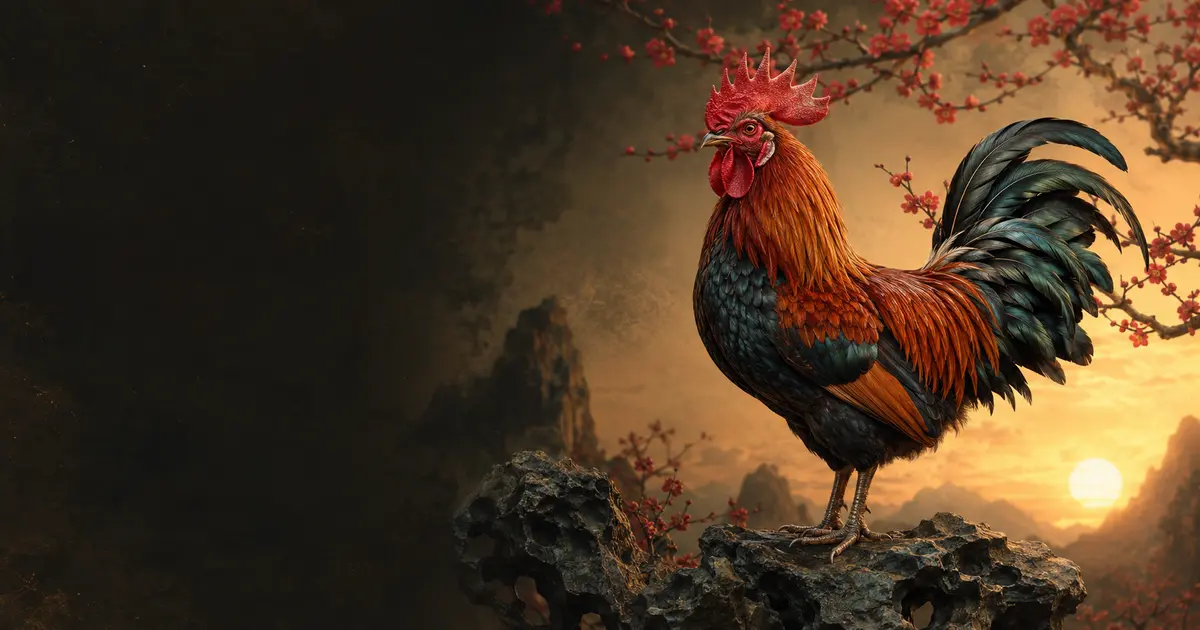
Rooster is the Chinese sign covering 1933, 1945, 1957, 1969, 1981, 1993, 2005, 2017. In this tradition it is the straight talker — precise, hardworking, and completely unwilling to pretend. It pairs most easily with Ox, Snake and Dragon, and finds Rabbit and Dog hardest. Below: personality, love, career, stones, and the period this sign is traditionally told to handle with care.
One caveat before you read on: the Chinese zodiac year starts at Lunar New Year, not January 1. If you were born in January or early February, check your birth date against the lunar calendar — you may belong to the previous year's animal.
Key facts
| Field | Value |
|---|---|
| Sign | Rooster |
| Tradition | Chinese zodiac |
| Years | 1933, 1945, 1957, 1969, 1981, 1993, 2005, 2017 |
| Position in the cycle | 10th |
| Fixed element | Metal |
| Polarity | Yin |
| Earthly branch | You (酉) |
| Best matches | Ox, Snake and Dragon |
| Hardest matches | Rabbit and Dog |
| Lucky numbers | 5, 7, 8 |
| Lucky colours | Gold, Brown, Yellow |
How This System Works
Your animal is set by the lunisolar year of your birth, not by the Gregorian one. The year turns at Lunar New Year, which falls somewhere between 21 January and 20 February depending on the new moon.
That single fact accounts for most confusion about the Chinese zodiac. Anyone born in January or the first three weeks of February belongs to the previous year's animal, and a calculator that simply divides the Gregorian year by twelve will tell them otherwise.
The twelve animals are the earthly branches, one half of the sexagenary cycle. The other half is ten heavenly stems, paired with the branches to give sixty distinct year names before the combination repeats. This is why a full traditional reading refers to a Metal Rat or a Water Tiger rather than to a Rat or a Tiger — the element comes from the stem, and it changes the reading.
Limits and Provenance
One of four pillars. In Ba Zi, the year animal is a quarter of the chart. Month, day and hour pillars each carry their own stem and branch, and practitioners generally treat the day pillar rather than the year as the one describing the person. A year-animal reading is the broadest possible cut.
The element matters. Two people sixty years apart share an animal and a stem; two people twelve years apart share only the animal. Any reading that ignores the stem is working with a fifth of the information.
And it describes a type, not a person. Nothing here anticipates events, and none of it is medical, financial or legal advice.
Rooster in Chinese usage
The branch is 酉 (yǒu) and the animal is 鸡 (jī).
闻鸡起舞 — "hear the cock and rise to practise", from a general who trained at every dawn crow. It is the idiom for self-imposed discipline, and it is a compliment. 鹤立鸡群, a crane standing in a flock of chickens, is the opposite view of the same bird.
In the Great Race. Tenth, and it found the raft. Without the Rooster the other two do not cross at all, which is the usual defence when the sign is dismissed as merely noisy.
Běnmìngnián: your own year is the difficult one
Western readers usually assume your own sign's year is your lucky one. Chinese tradition says the opposite.
本命年 (běnmìngnián) is the year your animal comes round again — every twelfth year, so at 12, 24, 36, 48 and so on. It is considered a year of friction rather than fortune, traditionally explained as offending 太岁 (Tài Suì), the deity of the year. The remedy is specific and still widely practised: wear red. Red underwear, a red belt, red socks, ideally given to you by an older relative rather than bought for yourself, worn through the year.
You will see this in shops in the run-up to Lunar New Year, stacked by the till, sized for adults. It is not a curiosity for tourists; it is an ordinary purchase made by people who would not describe themselves as superstitious.
The practical reading, if you want one that survives translation: the years your sign returns are the ones the tradition tells you to be deliberate in. Take that as a prompt rather than a forecast.
The Great Race, and why there is no cat
The order of the twelve is explained by a race. The Jade Emperor summoned the animals and set the sequence by who arrived first, which is why the Rat — the smallest and least powerful — opens the cycle, and why the Dragon does not.
The story is also the answer to the question everyone eventually asks. The Rat and the Cat were friends and agreed to travel together; the Rat did not wake the Cat, and the Cat missed the race entirely. That is the traditional Chinese explanation for the cat's absence, and for why cats and rats have not got along since.
Vietnam tells the cycle differently: there, the fourth branch is a cat. The likeliest explanation is linguistic rather than mythological — the branch name mǎo is close to Vietnamese mèo, cat.
Rooster personality: core traits
The defining Rooster trait is candour backed by preparation. This sign says what it sees, and it is usually right, because it has done the work — Roosters are notably diligent and notably well-organised.
Underneath the sharpness is real reliability and pride in standards. Roosters keep their commitments, present themselves carefully, and are traditionally read as the sign that announces the truth whether or not it is welcome.
The classical shadow is criticism that lands as contempt. A Rooster can correct people who did not ask, hold a standard nobody agreed to, and be so certain of its own accuracy that it stops hearing a reasonable objection.
See where this pattern lands in your chart.
Create a free account to find your Rising sign and read your own birth chart in plain English.
What each Rooster trait is good for
Candour backed by preparation
The candour is worth something because the homework is done. A Rooster who says the numbers do not work is usually the only person in the room who has checked, which is precisely the correction that saves a project.
Try this: Lead with the work, not the verdict. "I went through it and here is what I found" gets acted on; the same conclusion stated flat gets argued with.
Reliability and standards
Keeping commitments is the most under-rated career advantage there is. Roosters become the person work is routed to, and routed work is how responsibility actually accumulates.
Try this: Publish the standard instead of enforcing it. A checklist other people can meet turns a personal standard into how the team works — and stops it landing as correction.
Criticism that lands hard
It is accuracy pointed without a cushion. The observation is generally correct, and correct observations are worth having; the problem is delivery, which is fixable in a way that being wrong is not.
Try this: Ask first, correct second. "Do you want notes?" costs three words and converts the same sentence from contempt into help.
Rooster in love and relationships
Roosters are devoted, practical and honest partners — you will always know where you stand. Affection tends to show as effort, punctuality and taking a partner's problems seriously enough to plan around them.
What a Rooster needs is appreciation and a partner who does not take the bluntness personally. This sign softens enormously when it feels genuinely admired rather than merely tolerated.
Best matches
- •Ox — They out-work everyone with you, wordlessly.
- •Snake — Precision meets depth; conversations feel like chess.
- •Dragon — Your secret ally: their fire showcases your polish.
Handle with care
- •Rabbit — Your clash sign — your candour cuts their calm.
- •Dog — Two critics, no audience — sparks turn to scorch.
Treat compatibility as a description of friction and ease, not a verdict. A difficult pairing is not doomed; it simply has to negotiate the thing that grinds, out loud and early.
Rooster at work and career
Rooster tends to do well in accounting and audit, surgery and dentistry, editing, law, the military, hospitality management, sales with a technical product, quality control and inspection. The common thread is not the industry but the conditions: this archetype needs work that uses its actual strength rather than work that merely tolerates it.
The career risk is delivery — the Rooster is often right and still loses the room, so the single highest-return change for this sign is separating the accuracy of a point from the way it is made.
Healing stones for Rooster
Stones are used symbolically here — as a focus for attention, not as a treatment for anything. These are the ones the tradition pairs with Rooster:
- •Citrine · warm confidence
- •Topaz · clear expression
- •Jade · steady reward
Your own years and Rabbit years
Your own animal year (Běn Mìng Nián) offends the Year God, and Rabbit years clash with your sign head-on — both bring turbulence. The traditional handling is caution rather than dread: treat it as a stretch for consolidating rather than for confronting, and expect the pressure to be strongest at the start.
Frequently asked questions
What years are Rooster years?
1933, 1945, 1957, 1969, 1981, 1993, 2005, 2017. Because the zodiac year begins at the lunisolar new year, a January or early-February birthday may fall under the previous animal.
Who is Rooster most compatible with?
Ox, Snake and Dragon are the traditional strong matches. Rabbit and Dog are the classic points of friction — which describes where the work is, not whether the relationship can succeed.
Is the Chinese zodiac based on the calendar year?
No — it follows the lunisolar year, which begins at Lunar New Year some time between 21 January and 20 February. Anyone born in that window needs to check their specific birth year, because the calendar-year animal and the zodiac-year animal disagree.
What careers suit Rooster?
The archetype fits accounting and audit, surgery and dentistry, editing, law, the military, hospitality management, sales with a technical product, quality control and inspection. Read that as a description of conditions this temperament thrives in rather than a list of correct jobs — plenty of people work happily against their sign's grain.
Is astrology scientifically proven?
No. Astrology is a symbolic and interpretive tradition, not an established scientific method for predicting personality or events. Omniscient Insight presents it as a tool for reflection and self-exploration, not as certainty, diagnosis, or professional advice.
Sources
The calendar mechanics — the lunisolar year, the stem-and-branch cycle, the new-year date range — are stated from the cited references and separated from the interpretation. The character material describes a traditional archetype attached to a birth year and is written as reflection rather than prediction. Nothing medical, financial or legal.
- •Chinese calendar — Encyclopaedia Britannica. The lunisolar year, the sexagenary stem-and-branch cycle, and why the zodiac year does not begin on 1 January.
- •Chinese zodiac — Encyclopaedia Britannica. The twelve-animal cycle, its twelve-year period, and its dependence on the lunar rather than the Gregorian year.
A note on this profile
This describes the shared Rooster archetype in Chinese astrology. It is a portrait of a sign, not a reading of a person — your birth year is one factor among many, and nothing here should be treated as a prediction or as advice about a real decision.
“These reading really are so on point. That I really wonder sometimes how it's possible to be so on point by just pulling a few cards.”
Anonymous
Tarot
See where this pattern lands in your chart.
Create a free account to find your Rising sign and read your own birth chart in plain English.
Free account · no credit card needed
Compare subscription plansDid this answer what you came for?
One tap. No account needed, and we don’t collect anything about you.