Why this matters
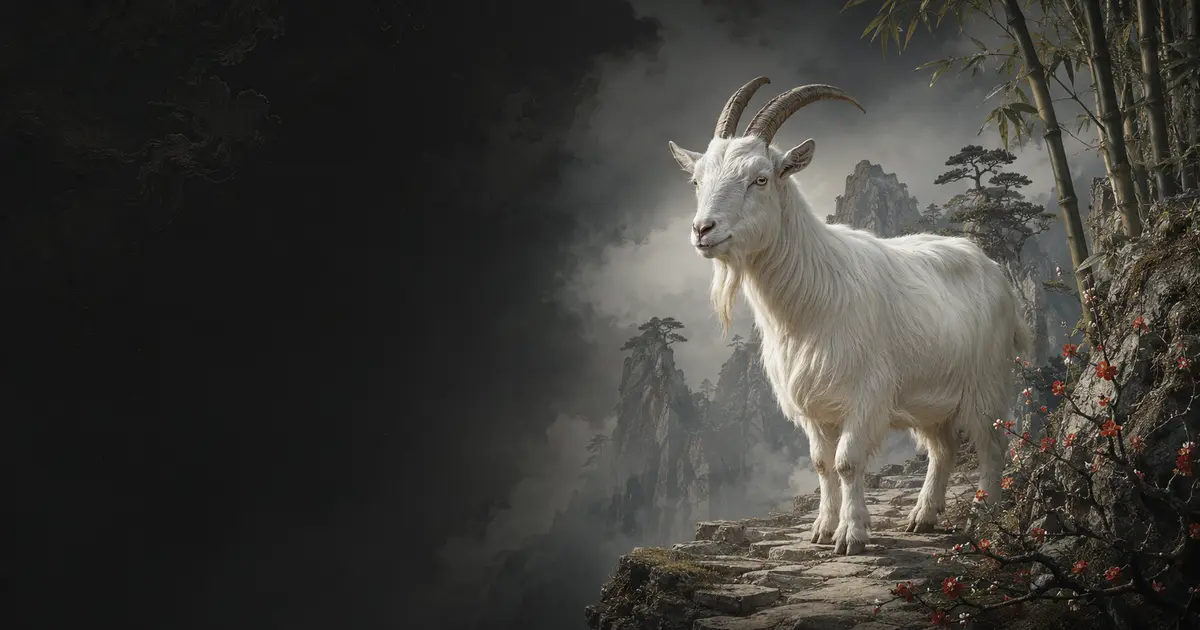
Goat in the Chinese zodiac: the artist — gentle, perceptive, and quietly uncompromising about beauty. Personality, love, career and compatibility.
Goat is the Chinese sign covering 1931, 1943, 1955, 1967, 1979, 1991, 2003, 2015. In this tradition it is the artist — gentle, perceptive, and quietly uncompromising about beauty. It pairs most easily with Rabbit, Pig and Horse, and finds Ox and Dog hardest. Below: personality, love, career, stones, and the period this sign is traditionally told to handle with care.
One caveat before you read on: the Chinese zodiac year starts at Lunar New Year, not January 1. If you were born in January or early February, check your birth date against the lunar calendar — you may belong to the previous year's animal.
Key facts
| Field | Value |
|---|---|
| Sign | Goat |
| Tradition | Chinese zodiac |
| Years | 1931, 1943, 1955, 1967, 1979, 1991, 2003, 2015 |
| Position in the cycle | 8th |
| Fixed element | Earth |
| Polarity | Yin |
| Earthly branch | Wei (未) |
| Best matches | Rabbit, Pig and Horse |
| Hardest matches | Ox and Dog |
| Lucky numbers | 2, 7 |
| Lucky colours | Brown, Red, Purple |
How This System Works
Your animal is set by the lunisolar year of your birth, not by the Gregorian one. The year turns at Lunar New Year, which falls somewhere between 21 January and 20 February depending on the new moon.
That single fact accounts for most confusion about the Chinese zodiac. Anyone born in January or the first three weeks of February belongs to the previous year's animal, and a calculator that simply divides the Gregorian year by twelve will tell them otherwise.
The twelve animals are the earthly branches, one half of the sexagenary cycle. The other half is ten heavenly stems, paired with the branches to give sixty distinct year names before the combination repeats. This is why a full traditional reading refers to a Metal Rat or a Water Tiger rather than to a Rat or a Tiger — the element comes from the stem, and it changes the reading.
Limits and Provenance
One of four pillars. In Ba Zi, the year animal is a quarter of the chart. Month, day and hour pillars each carry their own stem and branch, and practitioners generally treat the day pillar rather than the year as the one describing the person. A year-animal reading is the broadest possible cut.
The element matters. Two people sixty years apart share an animal and a stem; two people twelve years apart share only the animal. Any reading that ignores the stem is working with a fifth of the information.
And it describes a type, not a person. Nothing here anticipates events, and none of it is medical, financial or legal advice.
Goat in Chinese usage
The branch is 未 (wèi) and the animal is 羊 (yáng).
亡羊补牢 — "mend the pen after the sheep is lost". Usually completed with 为时未晚, "it is not too late": the point is not that you were careless but that repair still counts.
In the Great Race. Eighth, arriving on a raft the Goat, Monkey and Rooster built and crossed together. It is the only cooperative finish in the race, and the three animals are traditionally read as an easy grouping because of it.
Běnmìngnián: your own year is the difficult one
Western readers usually assume your own sign's year is your lucky one. Chinese tradition says the opposite.
本命年 (běnmìngnián) is the year your animal comes round again — every twelfth year, so at 12, 24, 36, 48 and so on. It is considered a year of friction rather than fortune, traditionally explained as offending 太岁 (Tài Suì), the deity of the year. The remedy is specific and still widely practised: wear red. Red underwear, a red belt, red socks, ideally given to you by an older relative rather than bought for yourself, worn through the year.
You will see this in shops in the run-up to Lunar New Year, stacked by the till, sized for adults. It is not a curiosity for tourists; it is an ordinary purchase made by people who would not describe themselves as superstitious.
The practical reading, if you want one that survives translation: the years your sign returns are the ones the tradition tells you to be deliberate in. Take that as a prompt rather than a forecast.
The Great Race, and why there is no cat
The order of the twelve is explained by a race. The Jade Emperor summoned the animals and set the sequence by who arrived first, which is why the Rat — the smallest and least powerful — opens the cycle, and why the Dragon does not.
The story is also the answer to the question everyone eventually asks. The Rat and the Cat were friends and agreed to travel together; the Rat did not wake the Cat, and the Cat missed the race entirely. That is the traditional Chinese explanation for the cat's absence, and for why cats and rats have not got along since.
Vietnam tells the cycle differently: there, the fourth branch is a cat. The likeliest explanation is linguistic rather than mythological — the branch name mǎo is close to Vietnamese mèo, cat.
Goat personality: core traits
The defining Goat trait is aesthetic and emotional sensitivity. This sign notices texture, mood and nuance that others do not register, and turns it into something — a room, an image, a way of being with people.
Underneath the mildness is real persistence in its own direction. Goats do not fight for territory, but they are very difficult to move off a personal value, and they tend to arrange their lives around it rather than argue about it.
The classical shadow is dependence and worry. A Goat can lean heavily on a stable partner or family, avoid decisions that require confrontation, and let anxiety about security shrink the life it actually wants.
See where this pattern lands in your chart.
Create a free account to find your Rising sign and read your own birth chart in plain English.
What each Goat trait is good for
Noticing what others miss
Goats register texture, mood and nuance below the threshold most people work at — the reason a room, an image or an occasion they arranged simply feels right. Taste is a rare and payable skill.
Try this: Say what you noticed, plainly. Goat perception is usually correct and usually unvoiced, so the value goes to whoever articulates it — make that you.
Quiet immovability
A Goat does not fight for territory but cannot be moved off a personal value, which produces a life genuinely arranged around what matters rather than argued about. That is unusual and it compounds.
Try this: State the value once, early, out loud. Arranging around it silently reads as passivity; named once, it is respected without a single argument.
Worry and leaning
The anxiety is a live risk model, and it is often right. Goats anticipate what actually goes wrong, which makes the sign a good early reader of an unstable plan or an unreliable person.
Try this: Give the worry one job a week. Write the specific fear, then the smallest thing that would reduce it, and do that — this converts a mood into maintenance.
Goat in love and relationships
Goats are tender, loyal, and attentive to a partner's inner state. This sign creates a genuinely comfortable shared life and is unusually forgiving of a partner's bad days.
What a Goat needs is stability and reassurance without condescension. Financial chaos and emotional unpredictability are especially hard on this sign; steadiness lets it do its best work.
Best matches
- •Rabbit — Two gentle souls — art, comfort, zero cruelty.
- •Pig — Generous hearts in the same rhythm.
- •Horse — Your secret ally: their energy carries your dreams.
Handle with care
- •Ox — Your clash sign — their rules bruise your feelings.
- •Dog — Their worry reads as criticism to your heart.
Treat compatibility as a description of friction and ease, not a verdict. A difficult pairing is not doomed; it simply has to negotiate the thing that grinds, out loud and early.
Goat at work and career
Goat tends to do well in art and illustration, interior and textile design, music, teaching, therapy and care work, gardening and floristry, craft and artisanal production, hospitality. The common thread is not the industry but the conditions: this archetype needs work that uses its actual strength rather than work that merely tolerates it.
The career risk is under-pricing and over-accommodating — the Goat will discount its work to avoid an awkward conversation, so a fixed rate decided in advance is worth more to this sign than any productivity gain.
Healing stones for Goat
Stones are used symbolically here — as a focus for attention, not as a treatment for anything. These are the ones the tradition pairs with Goat:
- •Emerald · heart resilience
- •Peridot · lightening worry
- •Rose Quartz · self-kindness
Your own years and Ox years
Your own animal year (Běn Mìng Nián) offends the Year God, and Ox years clash with your sign head-on — both bring turbulence. The traditional handling is caution rather than dread: treat it as a stretch for consolidating rather than for confronting, and expect the pressure to be strongest at the start.
Frequently asked questions
What years are Goat years?
1931, 1943, 1955, 1967, 1979, 1991, 2003, 2015. Because the zodiac year begins at the lunisolar new year, a January or early-February birthday may fall under the previous animal.
Who is Goat most compatible with?
Rabbit, Pig and Horse are the traditional strong matches. Ox and Dog are the classic points of friction — which describes where the work is, not whether the relationship can succeed.
Is the Chinese zodiac based on the calendar year?
No — it follows the lunisolar year, which begins at Lunar New Year some time between 21 January and 20 February. Anyone born in that window needs to check their specific birth year, because the calendar-year animal and the zodiac-year animal disagree.
What careers suit Goat?
The archetype fits art and illustration, interior and textile design, music, teaching, therapy and care work, gardening and floristry, craft and artisanal production, hospitality. Read that as a description of conditions this temperament thrives in rather than a list of correct jobs — plenty of people work happily against their sign's grain.
Is astrology scientifically proven?
No. Astrology is a symbolic and interpretive tradition, not an established scientific method for predicting personality or events. Omniscient Insight presents it as a tool for reflection and self-exploration, not as certainty, diagnosis, or professional advice.
Sources
The calendar mechanics — the lunisolar year, the stem-and-branch cycle, the new-year date range — are stated from the cited references and separated from the interpretation. The character material describes a traditional archetype attached to a birth year and is written as reflection rather than prediction. Nothing medical, financial or legal.
- •Chinese calendar — Encyclopaedia Britannica. The lunisolar year, the sexagenary stem-and-branch cycle, and why the zodiac year does not begin on 1 January.
- •Chinese zodiac — Encyclopaedia Britannica. The twelve-animal cycle, its twelve-year period, and its dependence on the lunar rather than the Gregorian year.
A note on this profile
This describes the shared Goat archetype in Chinese astrology. It is a portrait of a sign, not a reading of a person — your birth year is one factor among many, and nothing here should be treated as a prediction or as advice about a real decision.
“These reading really are so on point. That I really wonder sometimes how it's possible to be so on point by just pulling a few cards.”
Anonymous
Tarot
See where this pattern lands in your chart.
Create a free account to find your Rising sign and read your own birth chart in plain English.
Free account · no credit card needed
Compare subscription plansDid this answer what you came for?
One tap. No account needed, and we don’t collect anything about you.