Why this matters
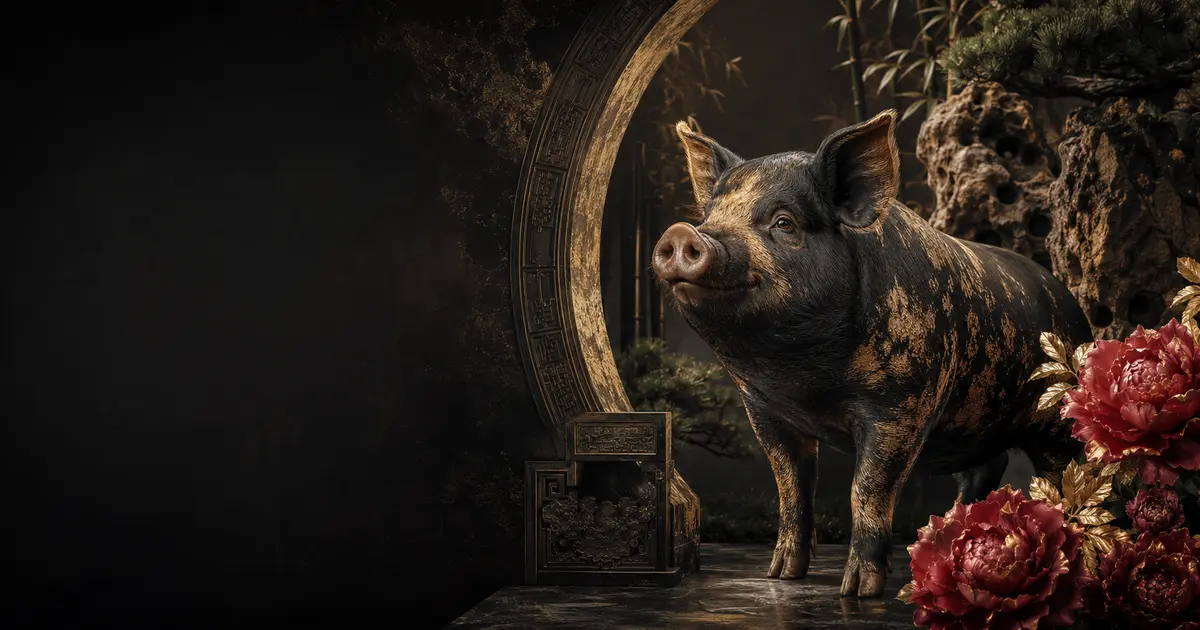
Pig in the Chinese zodiac: the good host — generous, sincere, and much shrewder than the warmth implies. Personality, love, career and compatibility.
Pig is the Chinese sign covering 1935, 1947, 1959, 1971, 1983, 1995, 2007, 2019. In this tradition it is the good host — generous, sincere, and much shrewder than the warmth implies. It pairs most easily with Goat, Rabbit and Tiger, and finds Snake and Monkey hardest. Below: personality, love, career, stones, and the period this sign is traditionally told to handle with care.
One caveat before you read on: the Chinese zodiac year starts at Lunar New Year, not January 1. If you were born in January or early February, check your birth date against the lunar calendar — you may belong to the previous year's animal.
Key facts
| Field | Value |
|---|---|
| Sign | Pig |
| Tradition | Chinese zodiac |
| Years | 1935, 1947, 1959, 1971, 1983, 1995, 2007, 2019 |
| Position in the cycle | 12th |
| Fixed element | Water |
| Polarity | Yin |
| Earthly branch | Hai (亥) |
| Best matches | Goat, Rabbit and Tiger |
| Hardest matches | Snake and Monkey |
| Lucky numbers | 2, 5, 8 |
| Lucky colours | Yellow, Grey, Brown |
How This System Works
Your animal is set by the lunisolar year of your birth, not by the Gregorian one. The year turns at Lunar New Year, which falls somewhere between 21 January and 20 February depending on the new moon.
That single fact accounts for most confusion about the Chinese zodiac. Anyone born in January or the first three weeks of February belongs to the previous year's animal, and a calculator that simply divides the Gregorian year by twelve will tell them otherwise.
The twelve animals are the earthly branches, one half of the sexagenary cycle. The other half is ten heavenly stems, paired with the branches to give sixty distinct year names before the combination repeats. This is why a full traditional reading refers to a Metal Rat or a Water Tiger rather than to a Rat or a Tiger — the element comes from the stem, and it changes the reading.
Limits and Provenance
One of four pillars. In Ba Zi, the year animal is a quarter of the chart. Month, day and hour pillars each carry their own stem and branch, and practitioners generally treat the day pillar rather than the year as the one describing the person. A year-animal reading is the broadest possible cut.
The element matters. Two people sixty years apart share an animal and a stem; two people twelve years apart share only the animal. Any reading that ignores the stem is working with a fifth of the information.
And it describes a type, not a person. Nothing here anticipates events, and none of it is medical, financial or legal advice.
Pig in Chinese usage
The branch is 亥 (hài) and the animal is 猪 (zhū).
猪朋狗友 — "pig friends and dog friends", the phrase for company that is fun and bad for you. The pig in idiom is comfortable and undiscriminating rather than stupid.
In the Great Race. Last, having stopped to eat and then to sleep. The Pig closes the cycle without apology, and the tradition reads the placement as contentment rather than failure — which is why Pig years are considered good ones to be born in.
Běnmìngnián: your own year is the difficult one
Western readers usually assume your own sign's year is your lucky one. Chinese tradition says the opposite.
本命年 (běnmìngnián) is the year your animal comes round again — every twelfth year, so at 12, 24, 36, 48 and so on. It is considered a year of friction rather than fortune, traditionally explained as offending 太岁 (Tài Suì), the deity of the year. The remedy is specific and still widely practised: wear red. Red underwear, a red belt, red socks, ideally given to you by an older relative rather than bought for yourself, worn through the year.
You will see this in shops in the run-up to Lunar New Year, stacked by the till, sized for adults. It is not a curiosity for tourists; it is an ordinary purchase made by people who would not describe themselves as superstitious.
The practical reading, if you want one that survives translation: the years your sign returns are the ones the tradition tells you to be deliberate in. Take that as a prompt rather than a forecast.
The Great Race, and why there is no cat
The order of the twelve is explained by a race. The Jade Emperor summoned the animals and set the sequence by who arrived first, which is why the Rat — the smallest and least powerful — opens the cycle, and why the Dragon does not.
The story is also the answer to the question everyone eventually asks. The Rat and the Cat were friends and agreed to travel together; the Rat did not wake the Cat, and the Cat missed the race entirely. That is the traditional Chinese explanation for the cat's absence, and for why cats and rats have not got along since.
Vietnam tells the cycle differently: there, the fourth branch is a cat. The likeliest explanation is linguistic rather than mythological — the branch name mǎo is close to Vietnamese mèo, cat.
Pig personality: core traits
The defining Pig trait is open-handed sincerity. This sign gives easily — time, money, the benefit of the doubt — and creates the kind of social warmth other people organise their lives around.
Underneath the easygoing manner is real diligence and a good head for comfort as an asset. Pigs work hard for the life they want and are traditionally associated with prosperity rather than laziness.
The classical shadow is naivety and indulgence. A Pig can keep giving to someone who has demonstrated they will take, avoid the confrontation that would fix it, and soothe stress in ways that cost more than the stress did.
See where this pattern lands in your chart.
Create a free account to find your Rising sign and read your own birth chart in plain English.
What each Pig trait is good for
Open-handed sincerity
Giving easily builds the social warmth other people organise their lives around, and that is durable: a Pig at the centre of a group is the reason the group keeps existing.
Try this: Give first and specifically. Generosity aimed at a named need is remembered; general goodwill is pleasant and forgotten.
Comfort as an asset
Pigs work hard for the life they want rather than for the score, which is a sound reason to work and produces a life that is actually pleasant to be in. The tradition ties this sign to prosperity, not laziness, for that reason.
Try this: Name the number. "Enough" is a decision, and Pigs who have made it explicitly stop over-giving to prove they are not indulgent.
Benefit of the doubt
Assuming good faith is right far more often than it is wrong, and it is why people tell a Pig things they tell nobody else. Most of the cost of cynicism is invisible; most of the benefit of trust is too.
Try this: Keep the warmth, add a count. Extend it freely the first time and the second; the third time is a pattern, and patterns get a conversation.
Pig in love and relationships
Pigs are warm, tolerant, affectionate partners who make the relationship easy to be in. This sign is generous with forgiveness and genuinely enjoys a shared, comfortable domestic life.
What a Pig needs is a partner who does not exploit the generosity. Being taken advantage of is the classic failure mode here, and this sign fares best with someone who insists on reciprocity for it.
Best matches
- •Goat — Kindness mirrored back — soft and true.
- •Rabbit — Comfort, honesty, and very good dinners.
- •Tiger — Your secret ally: their courage defends your open heart.
Handle with care
- •Snake — Your clash sign — their layers unsettle your candour.
- •Monkey — You give sincerely; they play sincerely.
Treat compatibility as a description of friction and ease, not a verdict. A difficult pairing is not doomed; it simply has to negotiate the thing that grinds, out loud and early.
Pig at work and career
Pig tends to do well in hospitality and restaurants, medicine and care work, retail, entertainment, philanthropy and fundraising, real estate, HR, the food and drink trade. The common thread is not the industry but the conditions: this archetype needs work that uses its actual strength rather than work that merely tolerates it.
The career risk is unpriced generosity — the Pig gives away time, favours and discounts that never come back, so this sign benefits from a simple rule about what is free and what is not.
Healing stones for Pig
Stones are used symbolically here — as a focus for attention, not as a treatment for anything. These are the ones the tradition pairs with Pig:
- •Ruby · joyful vitality
- •Rose Quartz · boundaried generosity
- •Jade · protected abundance
Your own years and Snake years
Your own animal year (Běn Mìng Nián) offends the Year God, and Snake years clash with your sign head-on — both bring turbulence. The traditional handling is caution rather than dread: treat it as a stretch for consolidating rather than for confronting, and expect the pressure to be strongest at the start.
Frequently asked questions
What years are Pig years?
1935, 1947, 1959, 1971, 1983, 1995, 2007, 2019. Because the zodiac year begins at the lunisolar new year, a January or early-February birthday may fall under the previous animal.
Who is Pig most compatible with?
Goat, Rabbit and Tiger are the traditional strong matches. Snake and Monkey are the classic points of friction — which describes where the work is, not whether the relationship can succeed.
Is the Chinese zodiac based on the calendar year?
No — it follows the lunisolar year, which begins at Lunar New Year some time between 21 January and 20 February. Anyone born in that window needs to check their specific birth year, because the calendar-year animal and the zodiac-year animal disagree.
What careers suit Pig?
The archetype fits hospitality and restaurants, medicine and care work, retail, entertainment, philanthropy and fundraising, real estate, HR, the food and drink trade. Read that as a description of conditions this temperament thrives in rather than a list of correct jobs — plenty of people work happily against their sign's grain.
Is astrology scientifically proven?
No. Astrology is a symbolic and interpretive tradition, not an established scientific method for predicting personality or events. Omniscient Insight presents it as a tool for reflection and self-exploration, not as certainty, diagnosis, or professional advice.
Sources
The calendar mechanics — the lunisolar year, the stem-and-branch cycle, the new-year date range — are stated from the cited references and separated from the interpretation. The character material describes a traditional archetype attached to a birth year and is written as reflection rather than prediction. Nothing medical, financial or legal.
- •Chinese calendar — Encyclopaedia Britannica. The lunisolar year, the sexagenary stem-and-branch cycle, and why the zodiac year does not begin on 1 January.
- •Chinese zodiac — Encyclopaedia Britannica. The twelve-animal cycle, its twelve-year period, and its dependence on the lunar rather than the Gregorian year.
A note on this profile
This describes the shared Pig archetype in Chinese astrology. It is a portrait of a sign, not a reading of a person — your birth year is one factor among many, and nothing here should be treated as a prediction or as advice about a real decision.
“These reading really are so on point. That I really wonder sometimes how it's possible to be so on point by just pulling a few cards.”
Anonymous
Tarot
See where this pattern lands in your chart.
Create a free account to find your Rising sign and read your own birth chart in plain English.
Free account · no credit card needed
Compare subscription plansDid this answer what you came for?
One tap. No account needed, and we don’t collect anything about you.