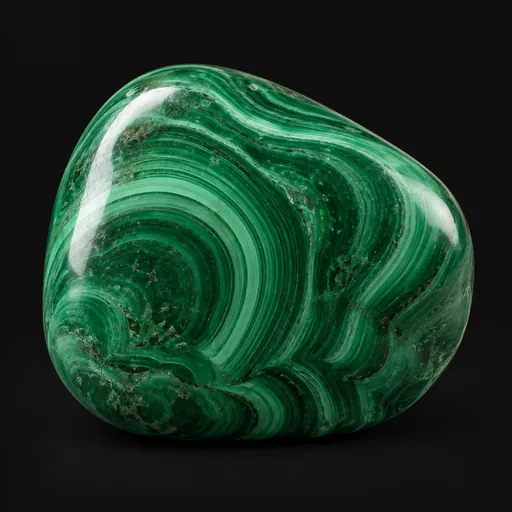
Malachite is a green copper mineral, often cut to reveal bands and rounded patterns. In this guide, those visible patterns become a personal prompt to review something you want to handle differently.
Try this today: write one situation that keeps recurring. Note what happens just before it, how you usually respond and one small response you could try next time.
Green on a stone, green in a painting
Malachite has a documented history as a pigment as well as an ornamental material. Its green colour could be used on a painted surface, while polished pieces could become objects or jewellery. Material and historical reference
The transformation here is a real change of use. It is not evidence that wearing malachite transforms a person's life. We do not need to invent a ceremony to connect the pattern with a reflection exercise.
The bands also make the individual piece important. A carefully chosen cut can reveal a pattern you will not find in quite the same form in another stone.
Give change a manageable size
If you want a different result, choose one response within your control. You might prepare a reply before an awkward request, put necessary items in one place or change the time you begin a task.
Keep your malachite beside the page where you record the experiment. After trying it, write what happened. The aim is to gather useful information, not prove that you have become a different person.
For another practice, use the pattern as a cue to name something you want to keep. A review can recognise what is working as well as what needs changing.
It is natural to want a fresh start without knowing how to make it last. A beautiful object can mark your intention, but a small action and a review date make it practical.
Choose a pattern you want to keep seeing
Ask for photographs of the actual piece. Look at the banding, the polish and the edges. A small cabochon or tumble can show plenty of character without a large display purchase.
Ask about coatings, reconstruction, imitations and treatment. A shop's claim about “transformation energy” does not answer those material questions.
Malachite is comparatively soft and sensitive to acids. Handle a finished piece gently, use a soft cloth and avoid soaking, harsh cleaners and ultrasonic equipment. Do not grind it or use it to prepare drinking water. Obtain specific care advice for mixed specimens or jewellery.
Compare Labradorite for a changing optical effect or Moss Agate for a gentler-looking pattern.
Choose malachite for the pattern that catches your attention. Put it beside one change you are testing. The next time the familiar situation appears, let the stone remind you of the response you prepared.
Ready to go deeper?
Did this answer your question?
Sources and calculation
Imported from the 58 stone article drafts. Planned daily release at 16:00 UTC; requires factual and editorial review before publication. Care and historical sources remain linked in the article. No invented legends or testimonials. Cover image and affiliate links require final setup.