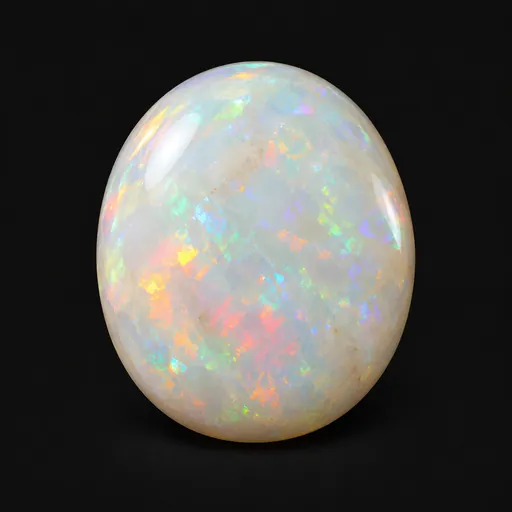
Opal is a silica-based gem material. Precious opal shows play-of-colour; common opal does not. Both can be attractive, but they are different visual choices. Here, we use opal as a personal symbol of possibility.
Try a quick creative exercise: write one idea, then list three versions of it. Choose the smallest version you could test.
The colour has a structure
GIA explains that the shifting colours of precious opal arise from light interacting with microscopic silica spheres. Their arrangement affects what you see as the stone moves. GIA’s description
This is a real optical effect. It does not require a supernatural explanation to be remarkable.
Opal also varies widely in body colour, transparency and form. A white opal, boulder opal and fire opal can offer very different appearances. A photograph of one variety should not set your expectations for all of them.
The material already supplies something distinctive to understand.
Use curiosity without losing a decision
If you hope to feel more creative, give yourself a task with a finish. Write three possible titles, sketch three layouts or describe three ways to spend an afternoon.
Place your opal beside the work as a cue to explore before choosing. Then pick one option and test it. Keeping every possibility open indefinitely is a different habit from making room for ideas.
For a personal reflection, ask what else could be true about a situation. List an alternative explanation, then identify what information would help you judge it.
You might worry about damaging a delicate purchase. That concern belongs in the buying decision. A piece you are afraid to use may suit a display setting better than daily jewellery.
Ask which kind of opal you are buying
Request the exact type, treatment information and whether it is solid, a doublet or a triplet. Those assembled forms need to be identified clearly. Ask for a turning video in ordinary light.
Choose a pendant or protected setting if knocks are likely. If you mainly want a desk object, a stable specimen may be more practical than a ring.
GIA recommends warm, soapy water for opal and warns about heat and sudden temperature changes. Composite pieces, absorbent varieties, treatments and settings may impose extra limits. Confirm those details rather than soaking an unidentified piece. Care guide
Compare Labradorite or Moonstone for other angle-dependent effects.
Choose the opal whose changing appearance you enjoy in everyday light. Let it accompany one experiment with an idea. The colours can keep moving while you choose your next step.
Ready to go deeper?
Did this answer your question?
Sources and calculation
Imported from the 58 stone article drafts. Planned daily release at 16:00 UTC; requires factual and editorial review before publication. Care and historical sources remain linked in the article. No invented legends or testimonials. Cover image and affiliate links require final setup.