Why this matters
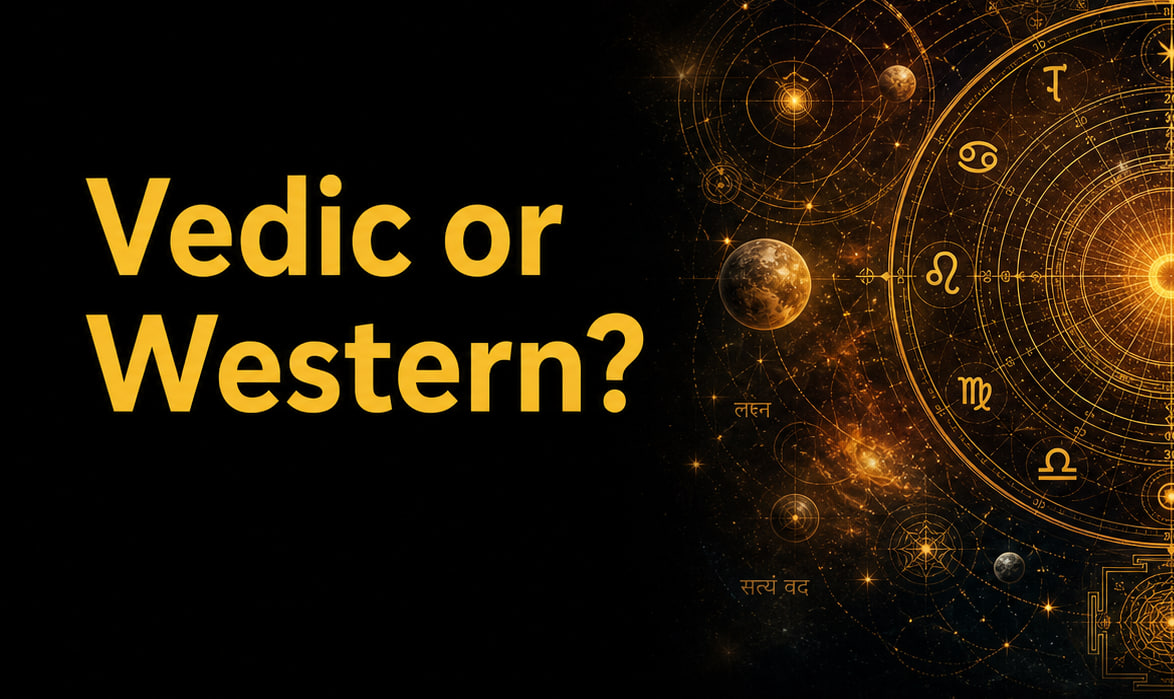
If you have ever looked up your Vedic chart and discovered your sun sign is different from your Western sign, you are not broken — the two systems use different zodiacs. Here is why they diverge, what each reveals, and why the Omni System uses both.
The Ayanamsa Shift
Western (tropical) astrology and Vedic (sidereal) astrology use different reference points for the zodiac. Western astrology fixes 0 degrees Aries to the vernal equinox — a seasonal marker. Vedic astrology fixes the zodiac to the actual position of the stars.
Due to the precession of the equinoxes (a slow wobble in Earth's axis), these two reference points have drifted apart by approximately 23-24 degrees. This means most people's Vedic sun sign is one sign earlier than their Western sun sign.
Example: If you are a Gemini Sun in Western astrology, you are likely a Taurus Sun in Vedic astrology.
This is not an error. It is two valid frameworks measuring from different starting points.
What Each System Emphasizes
| Dimension | Western Astrology | Vedic Astrology |
|---|---|---|
| Zodiac type | Tropical (season-based) | Sidereal (star-based) |
| Primary focus | Psychological growth, self-awareness | Karma, dharma, predictive timing |
| Key technique | Transits, progressions, aspects | Dasha periods, Nakshatras, divisional charts |
| Outer planets | Uranus, Neptune, Pluto used extensively | Traditional: Sun through Saturn only (some modern Vedic astrologers include outers) |
| Moon emphasis | Important but secondary to Sun | Primary — your Nakshatra (lunar mansion) is the first thing a Vedic astrologer examines |
| Predictive strength | Moderate — focuses on psychological themes | Strong — Dasha system provides specific timing windows |
Nakshatras: The Vedic Lunar Mansions
Vedic astrology divides the zodiac into 27 Nakshatras — lunar mansions of 13 degrees 20 minutes each. Your birth Nakshatra (determined by your Moon's position) reveals your emotional temperament, instinctive reactions, and karmic themes with far more precision than a Sun sign alone.
Each Nakshatra has:
- •A ruling deity (mythological archetype)
- •A ruling planet (determines your starting Dasha period)
- •A symbol (encoded meaning)
- •A shakti (power or purpose)
For example, someone born with Moon in Ashwini Nakshatra (0-13:20 Aries in sidereal) is ruled by the Ashwini Kumaras — twin horsemen of healing. The shakti is the power to heal and transform quickly. These individuals are often drawn to medicine, emergency response, or any field requiring swift decisive action.
See where this pattern lands in your chart.
Create a free account to find your Rising sign and read your own birth chart in plain English.
The Dasha System: Predictive Timing
The most powerful tool unique to Vedic astrology is the Dasha (planetary period) system. Based on your Moon's Nakshatra at birth, Vedic astrology calculates a sequence of planetary periods that unfold across your entire life.
Each Dasha period activates the themes of its ruling planet. A Saturn Dasha (lasting 19 years) brings discipline, restriction, karmic lessons, and eventual mastery. A Venus Dasha (20 years) brings relationships, pleasure, creativity, and aesthetic refinement.
Knowing which Dasha you're in is powerful context for a Vedic practitioner — though it's not something Omniscient Insight currently calculates.
Where Omniscient Insight Stands Today
Omniscient Insight currently reads your chart through Western (tropical) astrology — your Sun, Moon, Rising, and the real-time transits ("Cosmic Weather") shaping the present moment. We don't offer Vedic astrology yet: no Nakshatras, no Dasha periods.
We're including this comparison because a lot of people discover their Vedic sun sign is different from their Western one and wonder which is "right" — the honest answer is neither is wrong, they're different lenses measuring from different starting points. If Vedic astrology is something you'd want to see here, we're always weighing what to build next.
“These reading really are so on point. That I really wonder sometimes how it's possible to be so on point by just pulling a few cards.”
Anonymous
Tarot
See where this pattern lands in your chart.
Create a free account to find your Rising sign and read your own birth chart in plain English.
Free account · no credit card needed
Compare subscription plansDid this answer what you came for?
One tap. No account needed, and we don’t collect anything about you.