
Why this matters
A stellium concentrates several planets in one sign, house, or conjunction chain, but astrologers disagree on the exact threshold.
A stellium is a concentration of several planets in one zodiac sign, one house, or a close chain of conjunctions. Astrologers do not use one universal threshold: some references count three or more planets, others require four or more, and some require the planets to be close enough to operate as an actual conjunction pattern. The safest reading begins by stating which definition you are using.
Definition
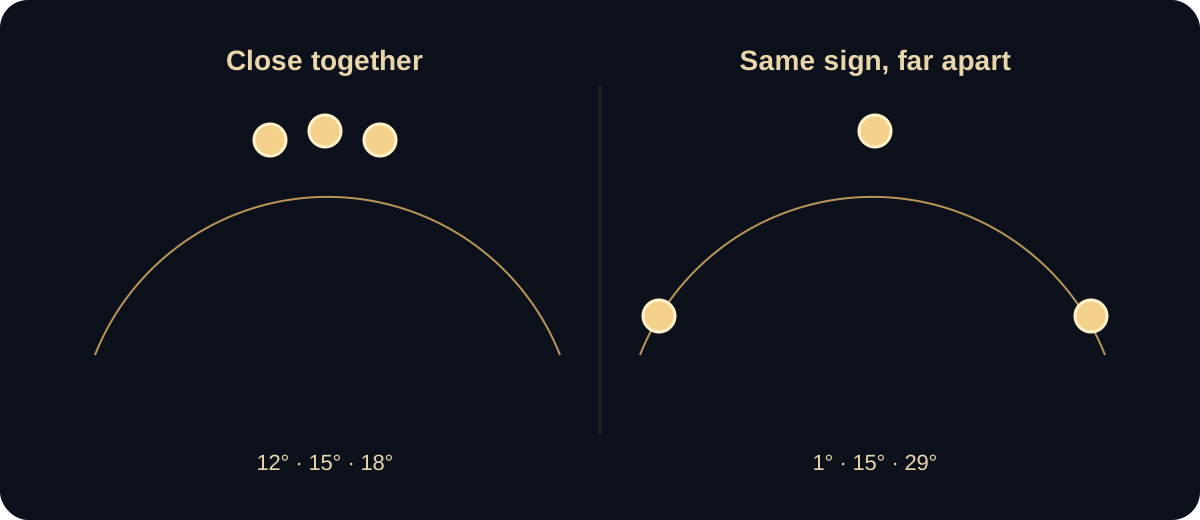
For this guide, use three or more planets in the same sign or house as a screening rule, then check their degrees before calling the pattern tight. If three planets occupy the same 30-degree sign but sit at 1°, 15°, and 29°, they share sign symbolism yet do not form the same compact configuration as planets at 12°, 15°, and 18°. “Concentration” is the common fact; the strength and coherence of the cluster still need interpretation.
Published practitioner references disagree about the threshold. The Astrology Dictionary documents definitions using three planets, four planets, or the looser phrase “several planets.” Llewellyn’s encyclopedia entry uses three or more planets in conjunction. That disagreement is not a flaw to hide. It is the reason a careful astrologer reports the planets, sign, house, degrees, and house system instead of treating the word stellium as a complete interpretation.
The Sun and Moon are normally counted as planets in astrological shorthand, even though astronomy classifies them differently. Angles such as the Ascendant and Midheaven, lunar nodes, asteroids, and calculated points may be important contacts, but counting them as planets silently changes the definition. List them as contacts to the stellium rather than using them to reach the minimum.
How to Find It
Start with a chart calculated from an accurate birth date, time, and place. A missing or approximate birth time can move house cusps and the Ascendant enough to change a house-based stellium. Sign positions usually remain usable over a day, although the Moon can change signs and should still be checked for the actual time.
- 1.List the Sun, Moon, Mercury, Venus, Mars, Jupiter, Saturn, Uranus, Neptune, and Pluto with exact zodiac degrees.
- 2.Group planets that share a sign. Mark any group of three or more as a candidate sign stellium.
- 3.Group planets by house using one named house system. Mark any group of three or more as a candidate house stellium.
- 4.Compare degrees. Note whether the planets form overlapping conjunction orbs or merely share a broad sign or house.
- 5.Record whether personal planets—the Sun through Mars—participate. A cluster of slow outer planets can describe a shared generational signature; personal-planet involvement makes the pattern more individually specific within astrological interpretation.
- 6.Check the dispositor: the planet traditionally or modernly said to rule the stellium’s sign. Its sign, house, and condition show where the concentrated pattern may seek an outlet.
House systems matter. Three planets can share a whole-sign house but fall on opposite sides of a quadrant-house cusp, or share a Placidus house while occupying two signs. Neither chart is “wrong”; the methods answer the spatial question differently. Report the method and notice which reading describes experience more usefully rather than switching systems only to manufacture a stellium.
How to Interpret It
Interpret the planets first. Each planet represents a different function in the symbolic language: Mercury differentiates and communicates, Venus evaluates and attracts, Mars pursues and separates, Saturn defines limits, and so on. A stellium does not melt them into one super-planet. It describes several functions repeatedly meeting in the same territory.
Interpret the sign as style. A Virgo cluster may approach several planetary functions through sorting, craft, correction, or usefulness; an Aquarius cluster may route them through systems, groups, abstraction, or independence. These are interpretive prompts, not fixed personality facts. Look for both capable and overextended forms of the sign instead of assigning only flattering traits.
Interpret the house as situation. A fourth-house stellium repeatedly pulls attention toward home, roots, private life, or family systems; a tenth-house stellium concentrates functions around public role, accountability, career, or reputation. Houses describe fields of experience, not a promise that every event in that field will be dramatic.
First House
The concentration meets identity, embodiment, initiative, and the way a person enters situations. Several planetary functions become immediately visible. The gift can be unmistakable presence; the balancing task is allowing relationships and feedback to modify self-definition without handing identity to other people.
Second House
Attention gathers around resources, income, possessions, skills, and the values used to make practical choices. The cluster may support sustained investment in capability. Its shadow is measuring safety or worth through accumulation alone; eighth-house exchange and shared accountability provide useful counterweight.
Third House
Learning, language, siblings, local movement, and everyday information become repeated sites of development. The mind may carry several simultaneous voices or methods. Depth improves when abundant communication is paired with ninth-house perspective: facts need a framework, and a persuasive explanation still needs ethical examination.
Fourth House
Home, ancestry, privacy, family systems, and emotional foundations receive concentrated attention. The pattern can build formidable inner continuity or caretaking capacity. The opposite tenth house asks how private loyalties relate to public responsibility, preventing inherited roles from quietly deciding every adult direction.
Fifth House
Creative authorship, play, pleasure, romance, performance, and relationships with children become a dense field of expression. Multiple planets can make creation feel necessary rather than optional. The balancing eleventh house asks how personal brilliance participates in community instead of depending exclusively on applause.
Sixth House
Workflows, service, maintenance, health routines, craft, and problem-solving host the concentration. The gift is often sustained attention to what makes life function. The shadow is endless optimization or usefulness as identity; twelfth-house rest, surrender, and unstructured time restore scale and compassion.
Seventh House
Partnership, contracts, negotiation, projection, and one-to-one encounter become major classrooms. Other people may reliably activate several planetary functions at once. The first-house counterpoint is essential: reciprocity works best when the person can state a position before adapting to a partner.
Eighth House
Shared money, debt, inheritance, trust, intimacy, grief, leverage, and irreversible transitions carry concentrated meaning. The gift can be courage around complexity and mutual obligation. Second-house clarity about personal resources and values helps prevent intensity, secrecy, or dependence from becoming the only proof of closeness.
Ninth House
Study, teaching, publishing, travel, belief, law, and encounters with larger frameworks receive repeated investment. Several planets here can produce a passionate maker of meaning. The third-house counterbalance requires checking grand conclusions against specific evidence, local language, and the people affected by an idea.
Tenth House
Career, public role, authority, reputation, and accountability become highly visible arenas. A person may develop several capacities through vocation or feel watched while doing so. Fourth-house roots and private life keep achievement from becoming the sole container for identity, care, or belonging.
Eleventh House
Friends, networks, audiences, institutions, collective projects, and future plans host the cluster. The gift can be coordination across many people or systems. Fifth-house authorship remains necessary: contribution loses vitality when group approval replaces personal delight, creative risk, or an individually chosen point of view.
Twelfth House
Solitude, retreat, endings, institutions, hidden labor, spiritual practice, and material outside immediate awareness become concentrated. The pattern may support deep imagination or service behind the scenes. Sixth-house routines provide grounding so privacy, sacrifice, or contemplation does not drift into avoidable isolation.
Then inspect aspects into and out of the cluster. A planet elsewhere in the chart that squares, opposes, or trines several members can become a recurring counterweight or resource. Because the cluster is dense, one transit can contact several natal planets in sequence. That creates a period with connected chapters, not proof that one predetermined event must occur.
Finally, look for counterbalance. Concentration is not the whole chart. The opposing sign and house can describe qualities that restore perspective; an unaffiliated planet can behave like a distinct voice; element and modality distribution can show resources the stellium itself does not emphasize. Interpretation improves when it asks how the chart redistributes attention rather than declaring one area all-powerful.
See where this pattern lands in your chart.
Create a free account to find your Rising sign and read your own birth chart in plain English.
Worked Examples
Worked example 1: A tight fifth-house Virgo cluster
Suppose Mercury at 10° Virgo, Venus at 13° Virgo, and Mars at 16° Virgo all occupy the fifth house. Under a three-planet definition, this is a clear stellium: one sign, one house, and a close chain of conjunctions. An astrologer might explore how thinking, evaluation, and pursuit repeatedly meet through creative practice, dating, performance, play, or work involving children.
The opportunity is disciplined craft: ideas can be revised into something usable, and affection may be expressed through careful attention. The shadow is turning pleasure into a permanent improvement project. The chart’s other placements decide whether this feels central, supported, conflicted, public, or private. The stellium identifies a concentration; it does not write the biography.
Worked example 2: A broad tenth-house cluster across a sign boundary
Imagine the Sun at 27° Libra, Mercury at 2° Scorpio, Venus at 8° Scorpio, and Saturn at 24° Scorpio, all in the tenth house under the selected quadrant system. This is plainly a house concentration and contains three planets in Scorpio, but the degrees are broad. Some astrologers would call the entire four-planet house group a stellium; others would call Mercury and Venus a conjunction within a heavily occupied house.
The useful reading does not depend on winning the label. Public role and accountability receive repeated emphasis, while Libra-to-Scorpio symbolism describes a movement from visible negotiation toward trust, strategy, disclosure, or control. Saturn at 24° may participate by house and sign without acting as part of the tighter Mercury-Venus pair. Precision produces more insight than insisting on one binary answer.
Generational concentration check
Uranus, Neptune, and Pluto move slowly, so people born in the same period can share sign combinations. If three outer planets appear together, note the pattern, but ask what makes it personal: Do they occupy an angle? Does the Moon or a personal planet aspect them closely? Do they rule important houses? Without such links, interpreting the cluster as a uniquely individual personality signature can overstate what a generation shares.
Gifts, Shadows, and Balancing Practices
Possible gifts: a stellium can concentrate practice, motivation, and fluency. Several planetary functions repeatedly working in one territory may help a person build unusual competence, recognize patterns quickly, or sustain attention after others move on. These are possibilities to test against experience, not traits guaranteed by a chart label.
Possible shadows: the same concentration can narrow perspective. The person may overidentify with one role, meet unrelated problems with the same strategy, or experience transits to the cluster as several connected demands. A difficult planet in the group is not a contaminant; it names a function whose limits, timing, conflict, or vulnerability must be integrated.
Balancing practices: identify the opposite sign and house, then choose one concrete behavior that develops their missing perspective. Give an unaspected or differently placed planet regular expression. Track which cluster planet is speaking during a decision instead of treating the group as one voice. Finally, follow the dispositor: strengthening the ruler’s constructive expression can give the concentrated energy somewhere coherent to go.
Limits and Variations
There is no scientific evidence that a stellium causes personality or life events. Astrology is an interpretive and divinatory tradition, distinct from astronomical calculation. A birth chart can organize reflection, but it should not replace evidence, consent, professional advice, or direct knowledge of a person.
Avoid three common shortcuts. First, do not count points as planets without saying so. Second, do not assume more planets means “more powerful” in every circumstance; coherence, angularity, rulership, aspects, and the rest of the chart matter. Third, do not interpret only the sign. A stellium in Gemini in the second house asks a different situational question from Gemini in the twelfth.
When definitions conflict, preserve the data. Say “three planets share Libra and the seventh house, within nine degrees” rather than merely “you have a stellium.” Another astrologer can then apply a different threshold without needing a different chart. That habit also protects the reader from exaggerated claims built on a label whose boundaries were never disclosed.
Sources
The Astrology Dictionary entry and Llewellyn encyclopedia entry document competing practitioner definitions. TIME's history of the zodiac supports the distinction between astronomy and astrology; it does not validate symbolic chart claims. The worked examples are original teaching examples and do not describe real people.
Ready to inspect the actual planets, degrees, houses, and ruler instead of guessing from a label? [Calculate your birth chart](/birth-chart), then apply the sequence in this guide.
Editorial record
How this article was verified
The guide compares published practitioner definitions, preserves disagreements instead of declaring a false consensus, and labels all chart meanings as symbolic interpretation rather than scientific fact.
Sources
- Stellium — The Astrology DictionarySupports: Documented disagreement among modern astrology references over three-versus-four-planet definitions and sign-versus-house grouping.
- Encyclopedia Term: Stellium — Llewellyn WorldwideSupports: A published practitioner definition using three or more conjunct planets and the interpretive idea of concentration.
- Where Do Zodiac Signs Come From? — TIMESupports: Historical distinction between astronomy as a science and astrology as a non-scientific interpretive tradition.
“These reading really are so on point. That I really wonder sometimes how it's possible to be so on point by just pulling a few cards.”
Anonymous
Tarot
See where this pattern lands in your chart.
Create a free account to find your Rising sign and read your own birth chart in plain English.
Free account · no credit card needed
Compare subscription plansDid this answer what you came for?
One tap. No account needed, and we don’t collect anything about you.