Why this matters
Pig in the Vietnamese zodiac: the good host — generous, sincere, and much shrewder than the warmth implies. Personality, love, career and compatibility.
Pig is the Vietnamese sign covering 1935, 1947, 1959, 1971, 1983, 1995, 2007, 2019. In this tradition it is the good host — generous, sincere, and much shrewder than the warmth implies. It pairs most easily with Goat, Cat and Tiger, and finds Snake and Monkey hardest. Below: personality, love, career, stones, and the period this sign is traditionally told to handle with care.
One caveat before you read on: the Vietnamese zodiac year turns at Tết, which follows the same lunisolar new year as the Chinese calendar rather than January 1. A January or early-February birthday may belong to the previous animal.
Key facts
| Field | Value |
|---|---|
| Sign | Pig |
| Tradition | Vietnamese zodiac |
| Vietnamese name | con lợn |
| Earthly branch | Hợi |
| Years | 1935, 1947, 1959, 1971, 1983, 1995, 2007, 2019 |
| Position in the cycle | 12th |
| Fixed element | Water |
| Polarity | Yin |
| Earthly branch | Hai (亥) |
| Best matches | Goat, Cat and Tiger |
| Hardest matches | Snake and Monkey |
| Lucky numbers | 2, 5, 8 |
| Lucky colours | Yellow, Grey, Brown |
How This System Works
Your animal is the earthly branch of the lunisolar year you were born into, counted from Tết Nguyên Đán rather than 1 January. The calendar section below covers how that year is computed and where it parts company with the Chinese one.
What is worth knowing first is the naming. Vietnamese rarely says "the year of the Tiger". It says the can chi name — a heavenly stem paired with the branch, năm Nhâm Dần — and the sixty-year pairing of ten stems against twelve branches is what lets an older relative date a birth year exactly from what sounds like a single phrase.
The branch also owns a double-hour of the day, a giờ, and traditional practice reads the hour branch alongside the year one. A reading built on the year alone is using the coarsest of the four available counts.
Limits and Provenance
A year animal is the broad cut. Traditional practice also reads the month, day and hour branches, and treats the year as the least personal of the four.
The calendar has moved within living memory. North Vietnam shifted its calculations to the UTC+7 meridian in 1967, putting its Tết on a different day from the South's. Anyone born in Vietnam around a new year in that period has a genuinely ambiguous animal, and a confident online calculator is not evidence either way.
The character reading is shared. Vietnam and China read this branch the same way; what is Vietnamese here is the calendar, the two swapped animals, and the cultural weight described above. This page says so rather than presenting borrowed material as local.
And it describes a type. Nothing here anticipates events, and none of it is medical, financial or legal advice.
Pig in Vietnamese usage
In Vietnamese the branch is Hợi and the animal is con lợn.
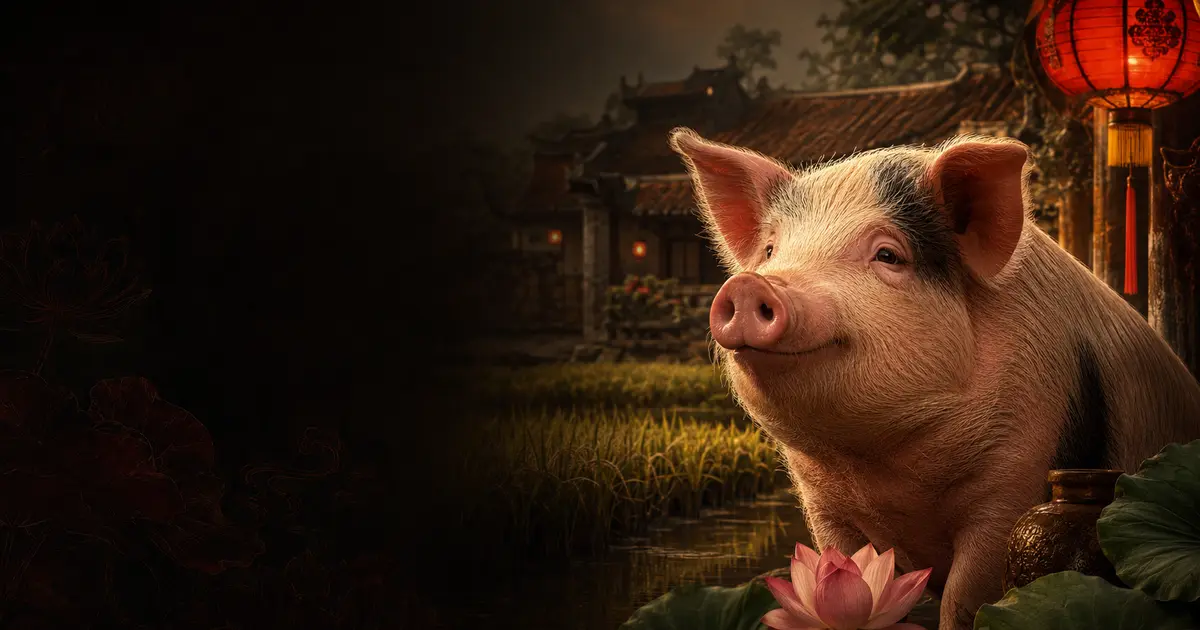
The pig is the Vietnamese emblem of a household that has enough. The Đông Hồ print of a sow with piglets, each marked with the âm dương whorl, was pasted up at Tết as a wish for abundance and children, and it remains one of the images most associated with the new year. The pig was also the household savings account in a literal sense — raised through the year, and killed for the feast that mattered. Hợi therefore reads as comfortable, generous and quietly well-provisioned, with the abundance understood as something accumulated rather than received.
Naming the year: can chi
Vietnamese does not usually say "the year of the Pig". It says the full can chi name — one of ten heavenly stems paired with the branch — which is why two Pig years sixty years apart share a name and two twelve years apart do not.
For this branch: Ất Hợi (1935), Đinh Hợi (1947), Kỷ Hợi (1959), Tân Hợi (1971), Quý Hợi (1983), Ất Hợi (1995), Đinh Hợi (2007), Kỷ Hợi (2019).
The stem is what a traditional reading uses alongside the animal, and it is also why an older relative can place your birth year exactly from a phrase that sounds to a learner like a single word. If you are looking your own year up, the pairing above is the form worth remembering.
How the Vietnamese cycle differs from the Chinese one
The twelve-year animal cycle is shared, and the order is the same. Two animals are not.
- •Sửu is a buffalo, not an ox. The water buffalo is the animal that actually worked Vietnamese paddies, so it is the one the branch names.
- •Mão is a cat, not a rabbit. The likeliest explanation is that the Sino-Vietnamese branch name mão is close to the Vietnamese mèo, cat. It is a regional tradition of long standing, not an error.
The larger difference is the calendar underneath. Vietnam and China both use a lunisolar calendar in which the year turns at the second new moon after the winter solstice, but each computes it for its own meridian — Vietnam at UTC+7, China at UTC+8. A new moon that falls in the hour between them lands on a different date in each calendar, so Tết and Chinese New Year occasionally fall a day apart, and a birthday inside that gap belongs to one animal in Vietnam and the previous one in China.
This is not only theoretical. North Vietnam moved its calendar calculations to the UTC+7 meridian in 1967, which put its Tết on a different day from the South's, still calculated on the older basis. Anyone born in Vietnam around a new year in that period has a genuinely ambiguous animal, and no amount of confidence from an online calculator settles it.
If your birthday falls in late January or early February, check it against a Vietnamese lunar calendar specifically rather than a generic Chinese one.
Xông đất: the first visitor at Tết
The zodiac is not only descriptive in Vietnam. It decides who is asked to walk through your door first.
Xông đất — literally "breaking the ground" — is the custom that the first person to enter a home after the new year turns sets the household's luck for the year. Families do not leave it to chance. Someone is invited in advance, and the choice is made on their animal, their age, and how the past year went for them: a person whose sign sits well with the head of the household, who is thought to be even-tempered, and who has visibly had a good year. Someone in their own năm tuổi — their zodiac year, traditionally a turbulent one — is usually not asked.
The practical consequence is that people do not drop in unannounced on the first morning of Tết. Turning up uninvited before the chosen visitor is a real discourtesy, not a minor one, and Vietnamese households take the sequence seriously enough to plan it days ahead.
If your own animal is being considered, the question being asked is not whether you are pleasant company. It is whether the year you have just had looks like one worth wishing onto someone else.
See where this pattern lands in your chart.
Create a free account to find your Rising sign and read your own birth chart in plain English.
Pig personality: core traits
The character reading below is the one the shared twelve-animal cycle gives this branch — Vietnam and China read this archetype the same way. What differs between them is the calendar and the cultural weight described above.
The defining Pig trait is open-handed sincerity. This sign gives easily — time, money, the benefit of the doubt — and creates the kind of social warmth other people organise their lives around.
Underneath the easygoing manner is real diligence and a good head for comfort as an asset. Pigs work hard for the life they want and are traditionally associated with prosperity rather than laziness.
The classical shadow is naivety and indulgence. A Pig can keep giving to someone who has demonstrated they will take, avoid the confrontation that would fix it, and soothe stress in ways that cost more than the stress did.
What each Pig trait is good for
A household that has enough
Hợi is the Tết emblem of abundance — the sow with piglets, pasted up for a full year ahead. The advantage is being the place other people can arrive at: a Pig's hospitality is genuine infrastructure in a family or a team.
Try this: Host on a schedule. Hợi's warmth converts into a durable circle when it is regular rather than occasional.
Accumulated, not received
The pig was the household savings account in a literal sense — raised through the year, spent on the feast that mattered. Hợi abundance is understood as built, which makes this sign patient with slow gains in a way quick temperaments are not.
Try this: Keep one thing compounding and untouched. Hợi does best with a long, boring accumulation running quietly behind the generosity.
Spending on what counts
The pig was raised all year and killed for the occasion that justified it. Knowing what an accumulation is for is the sign's real skill, and it is the reason Hợi generosity rarely reads as waste.
Try this: Decide the occasion in advance. A named purpose is what separates Hợi provision from indulgence — and it is the difference the tradition itself draws.
Pig in love and relationships
Pigs are warm, tolerant, affectionate partners who make the relationship easy to be in. This sign is generous with forgiveness and genuinely enjoys a shared, comfortable domestic life.
What a Pig needs is a partner who does not exploit the generosity. Being taken advantage of is the classic failure mode here, and this sign fares best with someone who insists on reciprocity for it.
Best matches
- •Goat — Kindness mirrored back — soft and true.
- •Cat — Comfort, honesty, and very good dinners.
- •Tiger — Your secret ally: their courage defends your open heart.
Handle with care
- •Snake — Your clash sign — their layers unsettle your candour.
- •Monkey — You give sincerely; they play sincerely.
Treat compatibility as a description of friction and ease, not a verdict. A difficult pairing is not doomed; it simply has to negotiate the thing that grinds, out loud and early.
Pig at work and career
Pig tends to do well in hospitality and restaurants, medicine and care work, retail, entertainment, philanthropy and fundraising, real estate, HR, the food and drink trade. The common thread is not the industry but the conditions: this archetype needs work that uses its actual strength rather than work that merely tolerates it.
The career risk is unpriced generosity — the Pig gives away time, favours and discounts that never come back, so this sign benefits from a simple rule about what is free and what is not.
Healing stones for Pig
Stones are used symbolically here — as a focus for attention, not as a treatment for anything. These are the ones the tradition pairs with Pig:
- •Ruby · joyful vitality
- •Rose Quartz · boundaried generosity
- •Jade · protected abundance
Your own years and Snake years
Your own animal year (năm tuổi) is traditionally turbulent, and Snake years clash with your sign head-on. The traditional handling is caution rather than dread: treat it as a stretch for consolidating rather than for confronting, and expect the pressure to be strongest at the start.
Frequently asked questions
What years are Pig years?
1935, 1947, 1959, 1971, 1983, 1995, 2007, 2019. Because the zodiac year begins at the lunisolar new year, a January or early-February birthday may fall under the previous animal.
Who is Pig most compatible with?
Goat, Cat and Tiger are the traditional strong matches. Snake and Monkey are the classic points of friction — which describes where the work is, not whether the relationship can succeed.
Why does the Vietnamese zodiac have a Cat instead of a Rabbit?
The Vietnamese cycle replaces the Rabbit with the Cat and the Ox with the Buffalo. The usual explanation is linguistic — the Chinese term for the fourth branch, mão, is close to the Vietnamese mèo, meaning cat — and the Buffalo simply reflects the animal that actually works Vietnamese fields. It is a genuine regional difference, not a mistranslation to be corrected.
Is the Vietnamese zodiac the same as the Chinese one?
Mostly, and not entirely. The twelve-year cycle and its order are shared, and the character reading for Pig is the same in both. Two animals differ — Vietnam counts a buffalo where China counts an ox, and a cat where China counts a rabbit — and the two calendars are computed for different meridians, so the years themselves occasionally start a day apart.
Can Tết and Chinese New Year fall on different days?
Yes. Both mark the same lunisolar new year, but Vietnam computes it for UTC+7 and China for UTC+8. When the relevant new moon falls in the hour between them, the two new years land on different dates — and a birthday in that gap belongs to one animal in Vietnam and the previous one in China.
Does my animal matter for xông đất?
It is one of the things considered. The first person to enter a home after the new year turns is chosen deliberately, and their zodiac animal, their age and how their past year went all come into it. Being a Pig neither qualifies nor disqualifies you on its own.
What is a Pig year called in Vietnamese?
By its full can chi name — a heavenly stem paired with the branch Hợi, as listed above — rather than by the animal alone. That is why an older relative can date your birth year exactly from what sounds like a single phrase.
Is astrology scientifically proven?
No. Astrology is a symbolic and interpretive tradition, not an established scientific method for predicting personality or events. Omniscient Insight presents it as a tool for reflection and self-exploration, not as certainty, diagnosis, or professional advice.
Sources
The calendar mechanics — the lunisolar year, the can chi cycle, the UTC+7 meridian and its consequences — are stated from the cited references and kept separate from the interpretation. Vietnamese cultural material is described ethnographically: proverbs, folk prints and living customs, not claims about individuals. The character reading is a shared archetype presented as reflection rather than prediction. Nothing medical, financial or legal.
- •Tết — Encyclopaedia Britannica. Tết Nguyên Đán as the Vietnamese lunisolar new year and the point at which the zodiac year turns.
- •Chinese calendar — Encyclopaedia Britannica. The lunisolar rule and the stem-and-branch cycle that Vietnam shares, computed for a different meridian.
A note on this profile
This describes the shared Pig archetype in Vietnamese astrology. It is a portrait of a sign, not a reading of a person — your birth year is one factor among many, and nothing here should be treated as a prediction or as advice about a real decision.
“These reading really are so on point. That I really wonder sometimes how it's possible to be so on point by just pulling a few cards.”
Anonymous
Tarot
See where this pattern lands in your chart.
Create a free account to find your Rising sign and read your own birth chart in plain English.
Free account · no credit card needed
Compare subscription plansDid this answer what you came for?
One tap. No account needed, and we don’t collect anything about you.